Archaeology · Turtkul District
Koi Krylgan Kala
The round temple of ancient Khorezm
Archaeology · Turtkul District
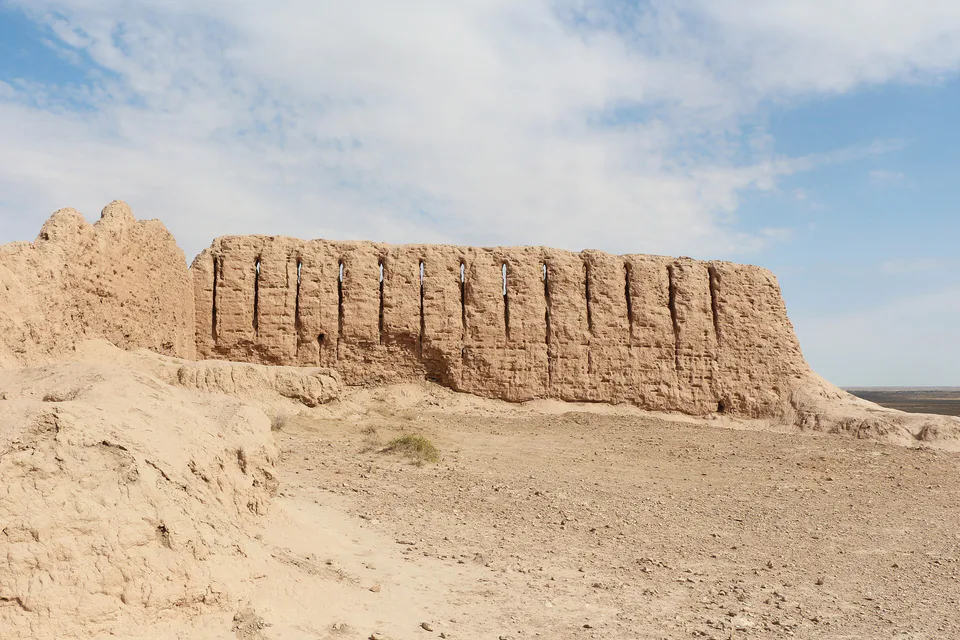
A rectangular fortified town of the 4th century BCE to 2nd century CE, with double walls, staggered arrow slits, a fire temple at the end of its main street and the remains of more than 300 houses.
Janbas Kala lies southeast of the Sultanuizdag hills and was explored in 1938–1939 by Sergey Tolstov’s Khorezm Archaeological and Ethnographic Expedition. It is a 200-by-170-metre rectangle enclosed by thick double walls of mud brick and rammed earth, still standing 10–11 metres high, with a 2.8-metre corridor between them and two rows of slanting arrow slits set chequerboard-fashion in the outer wall.
A street from the gate divided the town into two equal halves and ended at a fire temple. More than 300 houses and small courtyards and a pottery kiln were excavated, along with fine wheel-made ceramics, including jugs with handles shaped like lions and other animals. Some of the beads came from Syria, Egypt and the northern Black Sea coast, evidence of ancient Khorezm’s far-flung trade. The town was abandoned in the 2nd century CE.
Far older remains lie nearby: the Stone Age camp of Janbas-4, important for understanding the early hunter-fishers of Khorezm, was found here.