Neanderthals hunted here, Alexander the Great’s armies marched through, Ulugh Beg charted the stars and caravans travelled the Silk Road. Scroll down — each era unfolds with its own events.
People have lived in what is now Uzbekistan for hundreds of thousands of years — from Neanderthal caves to the fortified settlements of the Bronze Age, a long road before written history.
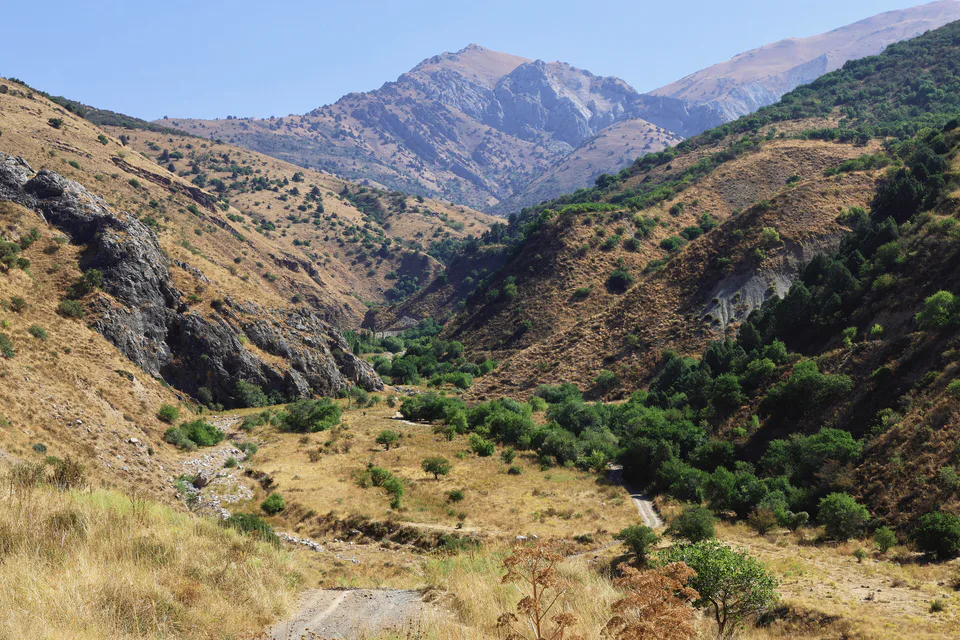
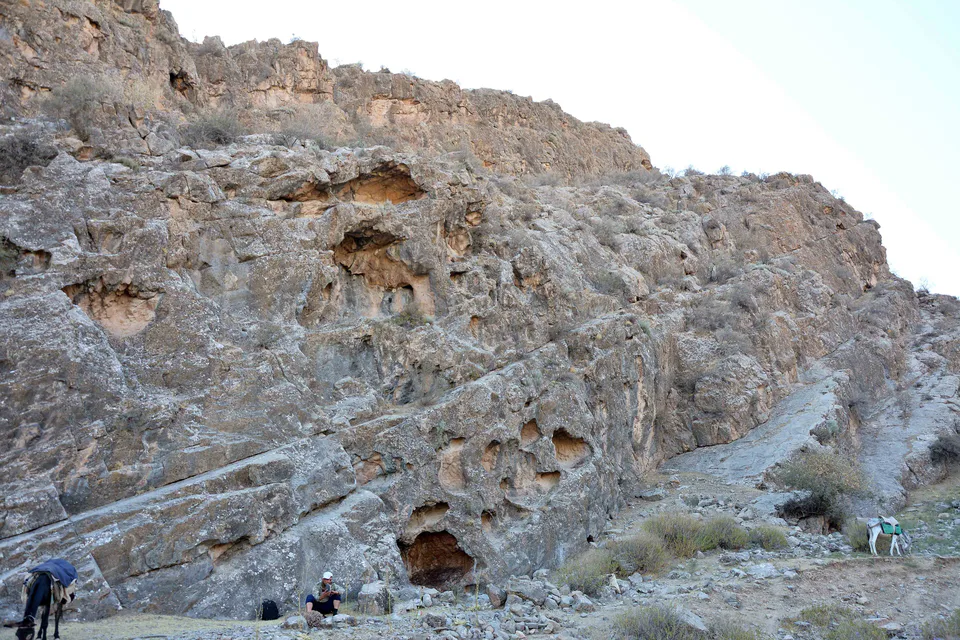
In 1938–1939 the archaeologist Alexey Okladnikov uncovered the skull and bones of a Neanderthal child, aged about eight or nine, in Teshik-Tash cave in the Baysuntau mountains. Ibex horn cores found around the skull led many scholars to see a deliberate burial, although others question that reading. The cave held five Mousterian layers, stone tools and hundreds of ibex bones. The remains are Middle Palaeolithic but have never been precisely dated. It was the first evidence that Neanderthals had lived in Central Asia. The cave lies in a remote gorge in Surkhandarya Region.
Obi-Rakhmat grotto, at 1,250 metres in the Paltau valley of Bostanliq district, was found in 1962 during a survey ahead of the Charvak reservoir. Its 10 metres of deposits, divided into 22 layers, preserve the stone tools of hunters who returned here over tens of thousands of years; dating methods place the sequence at roughly 80,000–40,000 years ago. In 2003 excavators recovered a child's teeth and skull fragments, attributed to Neanderthals or a closely related population. The site lies about 100 km north-east of Tashkent, close to the Chimgan and Charvak resort area.
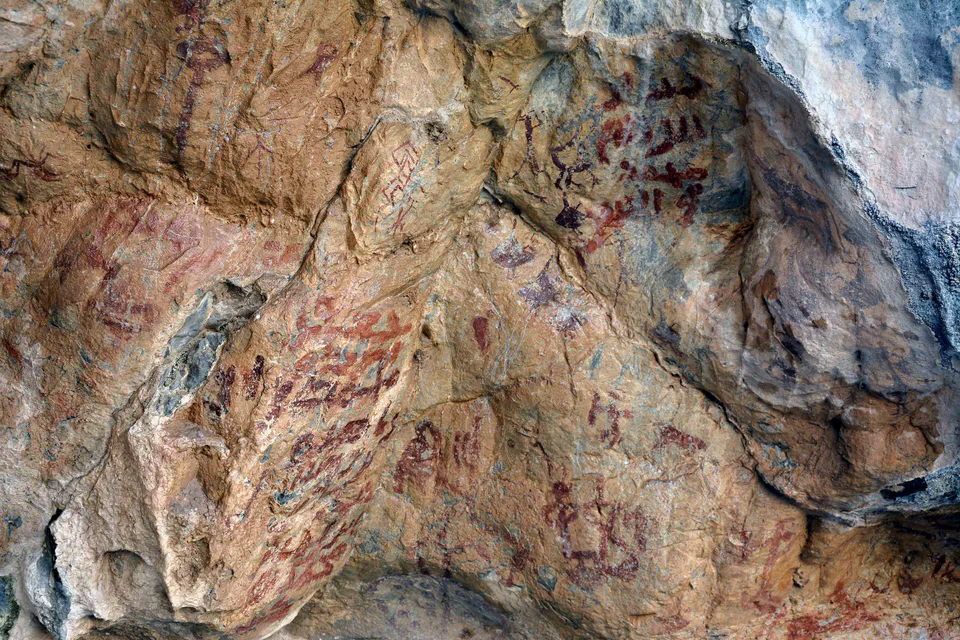
In the Zaraut-Sai gorge of Sherabad district, about 100 km from Termez, rock shelters preserve hunting scenes painted in red ochre. A local hunter, I. F. Lamaev, reported them in 1939, and researchers including G. V. Parfyonov, A. Roginskaya and A. Formozov later studied them. The images show hunters in bird-like disguises closing in on wild bulls, along with dogs and bows. Datings vary from the Mesolithic to the Neolithic, roughly the 12th to 5th millennium BC, and later images and inscriptions were added over time. It is Uzbekistan's best-known site of prehistoric art.
The Kelteminar culture: fishers of the Amu Darya delta
During the Neolithic, hunter-fishers living in the Amu Darya and Zeravshan deltas and on the fringes of the Kyzylkum and Karakum deserts created what archaeologists call the Kelteminar culture. It was identified in 1939 by Sergei Tolstov's Khorezm Archaeological-Ethnographic Expedition and named after a site by the Kelteminar canal in Karakalpakstan. Kelteminar communities lived in large timber-and-reed houses holding an entire clan, made hand-built pottery and tiny flint arrowheads, and wore shell beads; over time they took up herding as well. The best-known site is Dzhanbas-Kala 4 in Karakalpakstan.
Near Sherabad in the Surkhandarya valley, archaeologists have uncovered fortified farming settlements of the Bronze Age. Sapallitepa, found by L. Albaum in 1968 and excavated in 1969–1974 by Askarali Askarov, was a square stronghold ringed by three walls, with residential quarters and potters' workshops. Nearby Djarkutan is far larger, a proto-town with a temple, a palace and craft districts. Both belong to the Bactria–Margiana Archaeological Complex of the 2nd millennium BC and show how deep the roots of farming run in southern Uzbekistan. Finds are displayed at the Termez Archaeological Museum.
The Chust culture: the Fergana Valley's first farmers
In the late Bronze and early Iron Age, roughly 1500–900 BC, a culture of settled farmers and herders flourished in the Fergana Valley. It takes its name from a site near the town of Chust in Namangan Region; Dalverzin in Andijan Region is another major settlement. Sites ranged from small hamlets to fortified towns of more than ten hectares. People grew barley, wheat and especially millet, stored grain in large pits and kept sheep, goats, cattle, horses and camels. They made hand-built painted pottery and used bronze and, later, iron tools — one of the oldest farming horizons in the valley.
Bactria, Sogdiana and Chorasmia were the first states on Uzbek soil. Under the Achaemenids, Alexander, the Greco-Bactrians, the Kushans and the Turks, the region became the heart of the Silk Road.
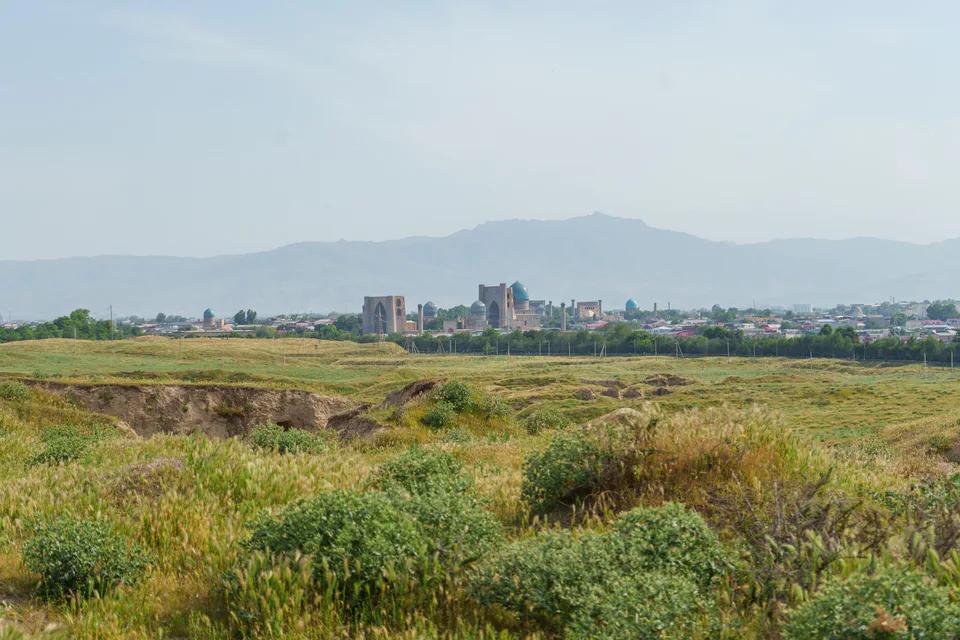
In the 8th–7th centuries BC the first cities rose in the oases of the Zeravshan and Kashkadarya rivers. Erkurgan, 10 km north-west of Karshi, holds the ruins of ancient Nakhshab: a pentagonal inner city of about 40 hectares behind massive walls, enlarged to 150 hectares when an outer wall was built in the 2nd century BC. Excavations revealed a citadel, a palace, a temple, a Zoroastrian dakhma and craft quarters. Around the same time urban life began on Afrasiyab, the ancient site of Samarkand, known to Greek writers as Maracanda. Both sites can be visited.
Bactria, Sogdiana and Chorasmia under the Achaemenids
In the mid-6th century BC the Persian king Cyrus II campaigned in Central Asia, and Bactria, Sogdiana and Chorasmia became provinces of the Achaemenid Empire. According to Herodotus, Cyrus died in 530 BC fighting the Massagetae, a story that, like the figure of Queen Tomyris, is partly legendary. Darius I's Behistun Inscription lists Bactria, Sogdiana and Chorasmia among the empire's satrapies; they paid tribute, and their envoys appear on the reliefs of Persepolis. Under Persian rule local towns were fortified and the Aramaic script and Zoroastrian traditions spread. The empire fell to Alexander in 330 BC.
In 329 BC Alexander the Great crossed the Hindu Kush and the Amu Darya and took Maracanda (Samarkand), the capital of Sogdiana. Resistance was fierce: a revolt led by the Sogdian Spitamenes tied the Macedonians down for nearly two years, and a whole detachment was destroyed on the Polytimetus, today's Zeravshan. Spitamenes was killed in 328 BC, and in 327 the fortress known as the Sogdian Rock fell. Alexander married Roxana, daughter of the Sogdian noble Oxyartes, sealing an alliance with the local aristocracy. Historians still debate the exact routes and the location of the fortresses.
After Alexander's death Central Asia passed to the Seleucids, and in the mid-3rd century BC Diodotus, governor of Bactria, founded an independent Greco-Bactrian Kingdom. For about a century it blended Greek and local culture on both banks of the Amu Darya: towns were laid out on Greek plans, theatres and temples appeared, and superb silver coins were struck. The fortress of Kampir Tepe near Termez guarded a river crossing, and some scholars identify it with Alexandria on the Oxus. In the mid-2nd century BC the kingdom fell to nomadic invaders, above all the Yuezhi.
From the 2nd century BC Chinese chronicles describe Kangju, a semi-nomadic, Eastern Iranian-speaking state in the Syr Darya basin, second in power only to the Yuezhi; the Tashkent oasis lay within its orbit. The ruined city of Kanka on the Akhangaran river is thought by archaeologists to have arisen in the 3rd–2nd centuries BC and survived until the 12th century, making it one of the oasis's first major towns. The name Chach appears in a 3rd-century inscription of the Sasanian king Shapur I. Tashkent's earliest layers, at Shashtepa and Mingurik, are dated to the same horizon, and the city celebrated its 2,200th anniversary in 2009.
In the 2nd century BC the Chinese envoy Zhang Qian reached the Fergana Valley and described Dayuan, a land of walled towns, farms and vineyards. What China coveted most were its tireless “blood-sweating” horses. In 104 BC the Han emperor Wu sent an army to obtain them; the first campaign failed, but the second, in 101 BC, besieged the capital Ershi and drove home several thousand horses. The war is often seen as the start of regular contact between China and Central Asia — the network later dubbed the Silk Road. The exact site of Ershi is still debated.
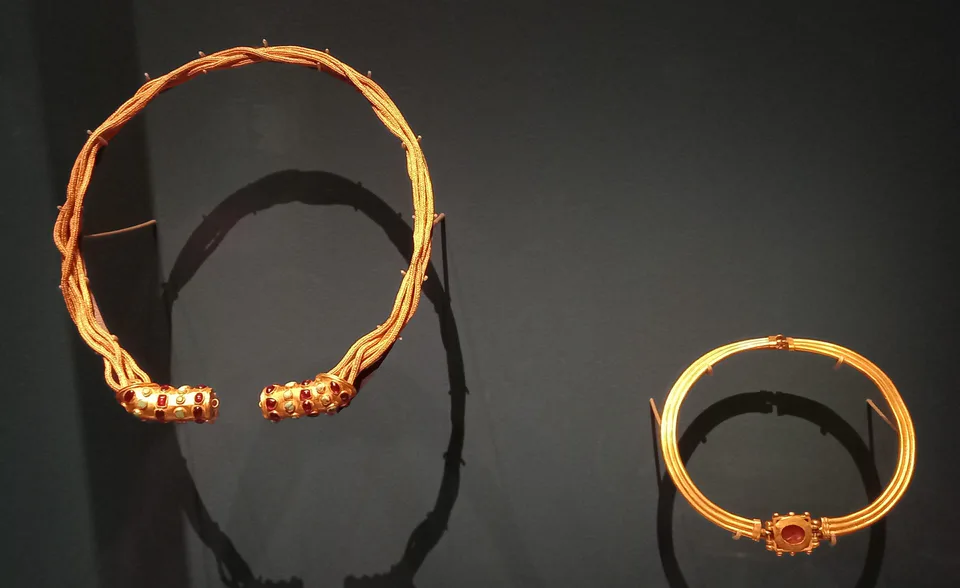
In the 1st century AD the Kushans, one of the Yuezhi tribes, united Bactria and built an empire stretching from the Amu Darya to northern India. Under Kanishka in the 2nd century it ranked alongside Rome, Parthia and Han China, and through it Buddhism spread into Central Asia and China. Dalverzin Tepe in Surkhandarya was an early Kushan centre: in 1972 excavators found a hoard of 115 gold objects weighing 36 kg in all, and a Buddhist shrine yielded sculpture, while the palace at Khalchayan preserved portraits of local rulers. Kushan art is on show at the Termez Archaeological Museum and the State Museum of History of Uzbekistan in Tashkent.
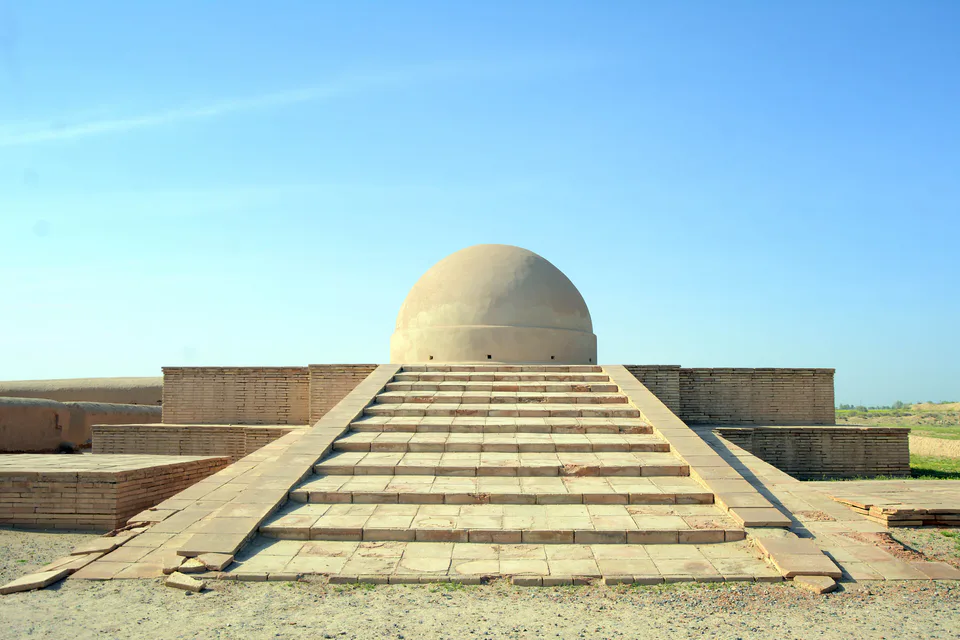
Under the Kushans, Old Termez on the Amu Darya grew into a major Buddhist centre. West of the city lie Kara Tepe, a complex of cave shrines and stupas, and Fayaz Tepe, a monastery founded in the 1st century that flourished in the 3rd–4th centuries and declined in the 5th. Most of its frescoes and reliefs, including the famous niche of the Buddha flanked by two monks (3rd–4th century), are now in the State Museum of History of Uzbekistan in Tashkent. Most Kushan and Kushano-Sasanian inscriptions come from these two monasteries. Today the restored stupa and monastery foundations of Fayaz Tepe, about 15 km from Termez, are open to visitors.
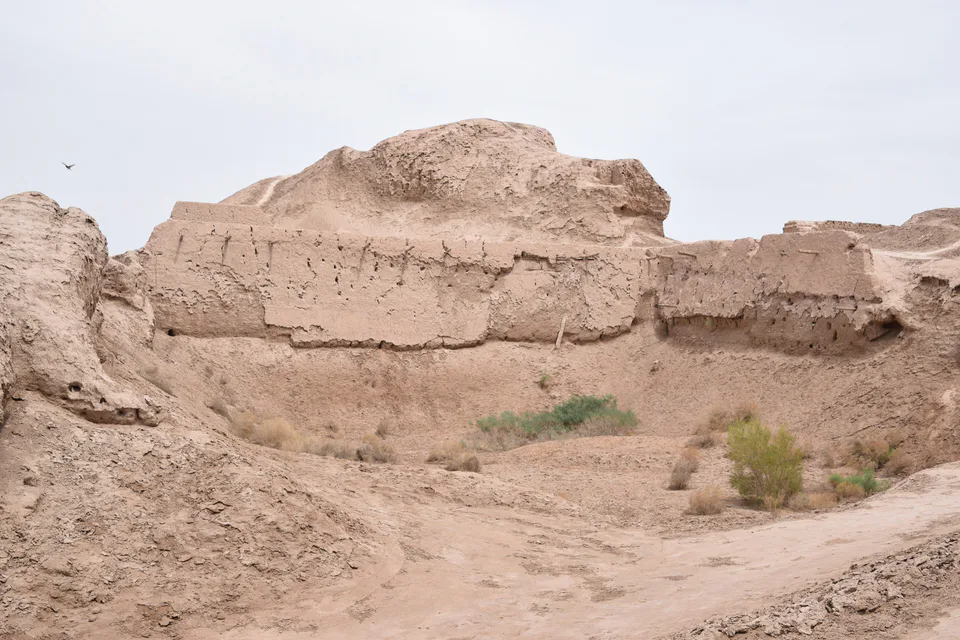
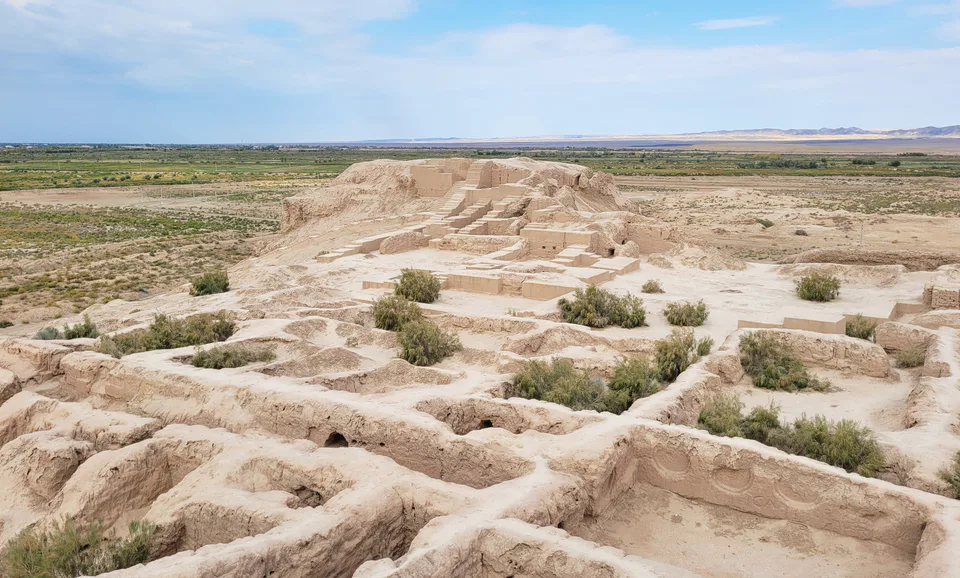
Toprak-Kala, in today's Ellikkala district, is believed to have been founded by the Khwarazmian king Artav in the 1st–2nd century AD and to have served as the capital in the 2nd–3rd centuries. From 1938 Sergei Tolstov's Khorezm Expedition uncovered a rigidly rectangular town and a vast palace on a high platform. Its halls yielded murals of Zoroastrian deities, sculpture, Khwarazmian and Kushan coins, and documents in the Khwarazmian language written on wood and leather. It is one of dozens of fortresses in the “Fifty Fortresses” oasis; together with nearby Ayaz-Kala and Kyzyl-Kala it forms Karakalpakstan's main archaeological route.
Between the 4th and 8th centuries the Sogdians — merchants from Samarkand, Bukhara, Kesh and Nakhshab — became the leading middlemen of the Silk Road, with communities from China and Mongolia to Crimea, and Sogdian served as a lingua franca of trade. Vivid proof came in 1907, when Aurel Stein found the Sogdian “Ancient Letters” in a watchtower near Dunhuang. Dated to around 313, they were written home by Sogdian traders in China: one reports the sack of Luoyang, another is a deserted wife's complaint to her husband. The letters are kept in the British Library.
The Turkic Khaganate and the fall of the Hephthalites
In 552 the Turkic Khaganate emerged on the steppes of the Altai and Mongolia. In the 560s the Turks, allied with Sasanian Iran, crushed the Hephthalites, and the lands up to the Amu Darya — Sogdiana, Chach and Fergana — passed under Turkic overlordship. Local Sogdian rulers kept their thrones by paying tribute, and the partnership of Turks and Sogdians boosted Silk Road trade. From 603 a separate Western Turkic Khaganate took shape. In 630 the Chinese monk Xuanzang passed through Chach and Samarkand on his way to India and described their prosperous cities. Turkic rule ended with the Arab arrival in the early 8th century.
Around 660 the walls of a hall in the palace of Varkhuman, ruler of Samarkand, were covered with vast paintings. They show embassies from many lands — Chinese, Koreans, Turks, envoys from Chaganian and Chach — as well as a Chinese princess in a boat and scenes of hunting and ritual; a Sogdian inscription names Varkhuman. The murals were found by chance in 1965 during road building on Afrasiyab. Today they are displayed in the Afrasiyab Museum, opened in 1970 over the very spot. They are the largest and best-known surviving works of Sogdian painting.
Five centuries between the Arab conquest and the Mongol invasion — the age of the Samanids, Karakhanids and Khwarazmshahs, when Transoxiana became a leading centre of learning and trade in the Islamic world.
Arab raids across the Amu Darya began in the late 7th century, but the decisive phase is linked to Qutayba ibn Muslim, governor of Khurasan. He took Paykend in 706 and Bukhara in 709, subdued Khwarazm and Samarkand in 712, and campaigned in Chach and Fergana in 713–715, before being killed by his own troops in Fergana in 715. Wars with Sogdian princes and the Turks dragged on for decades. The region became known as Mawarannahr, “the land beyond the river”. Islam spread gradually over several generations, and Arabic became the language of scholarship, laying the ground for the intellectual flowering to come.
From 776 to 783 Transoxiana was shaken by a major revolt against the Abbasid Caliphate. It was led by Hashim ibn Hakim, called al-Muqanna, “the Veiled One”, for the veil he wore; sources variously make him a native of Merv or of Balkh. His followers wore white in defiance of the black of the caliph's partisans, and they drew support from Sogdian peasants and Turkic tribes. Centres of the rising included the Samarkand countryside, Narshakh near Bukhara and the mountain fortress of Sanam in the Kesh region. When Sanam fell in 783, al-Muqanna took his own life rather than be captured. Legend has it that he raised an artificial “moon” from a well at Nakhshab.
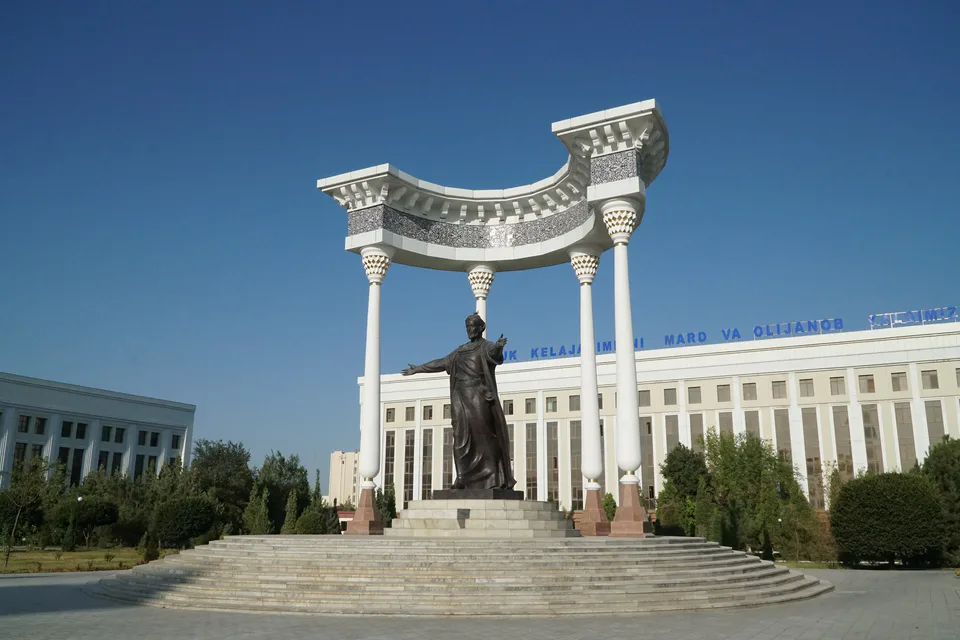
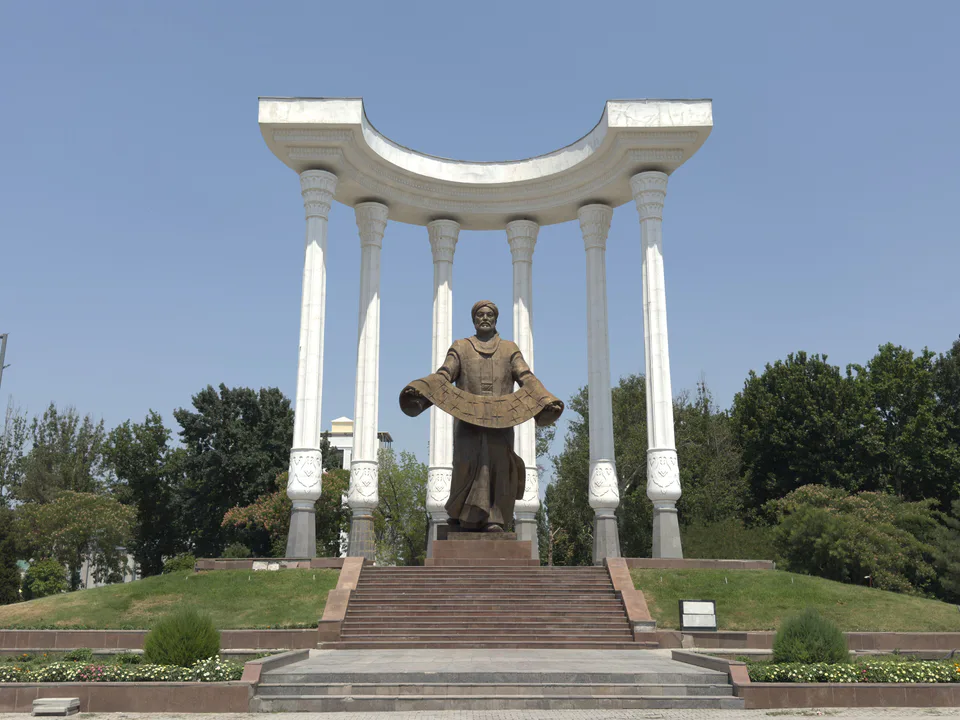
Under the caliph al-Ma'mun, the Khwarazmian scholar Muhammad ibn Musa al-Khwarizmi, working at Baghdad's House of Wisdom, wrote “The Compendious Book on Calculation by Completion and Balancing” some time between 813 and 833. It set out systematic methods for solving linear and quadratic equations, and its key term al-jabr gave its name to algebra. His treatise on Indian numerals circulated in Latin as “Algoritmi de numero Indorum”, the origin of the word “algorithm”. A statue of al-Khwarizmi stands by the gate of Itchan Kala in Khiva, and Urgench State University bears his name.
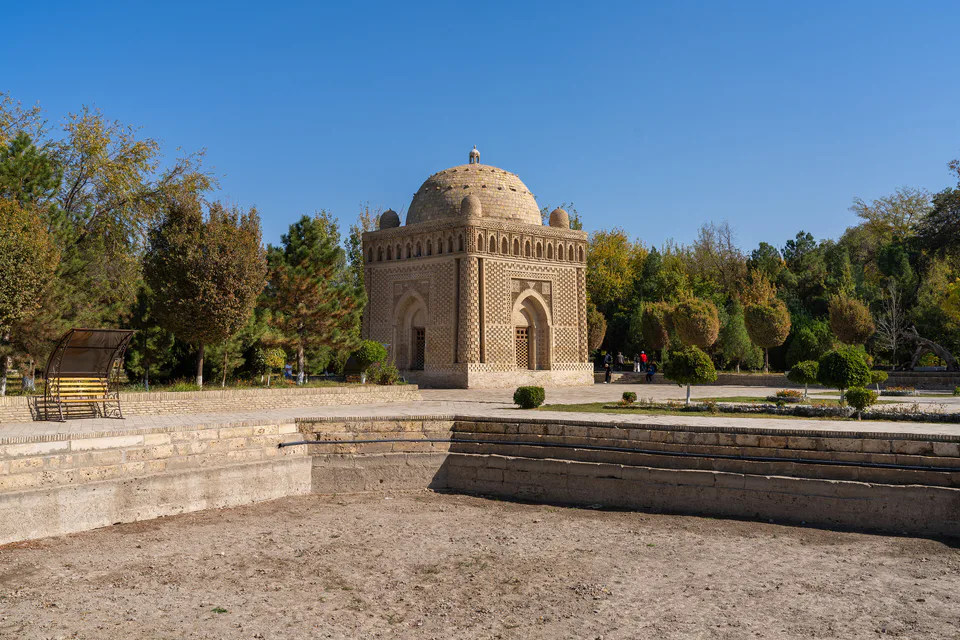
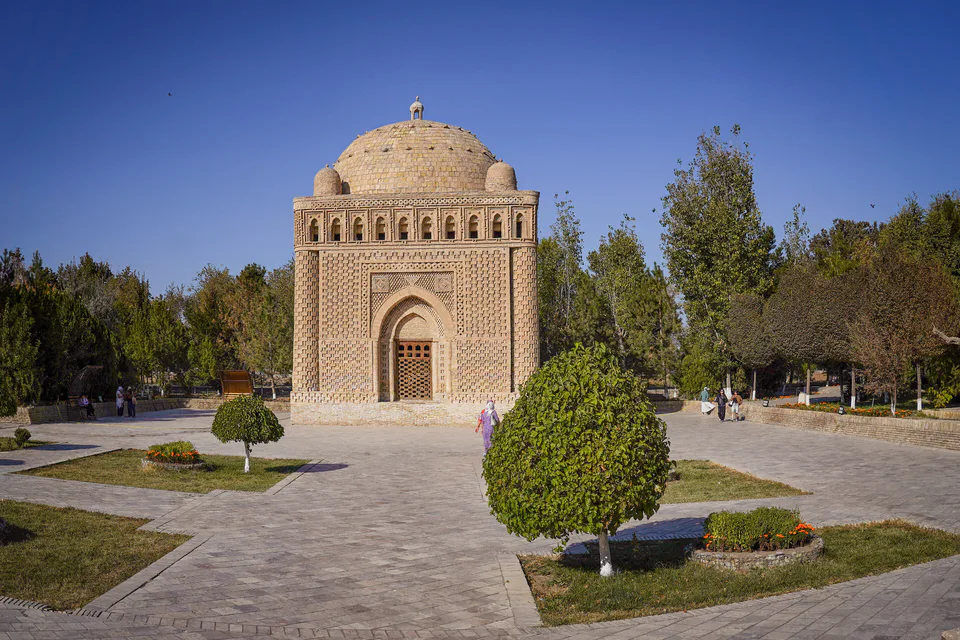
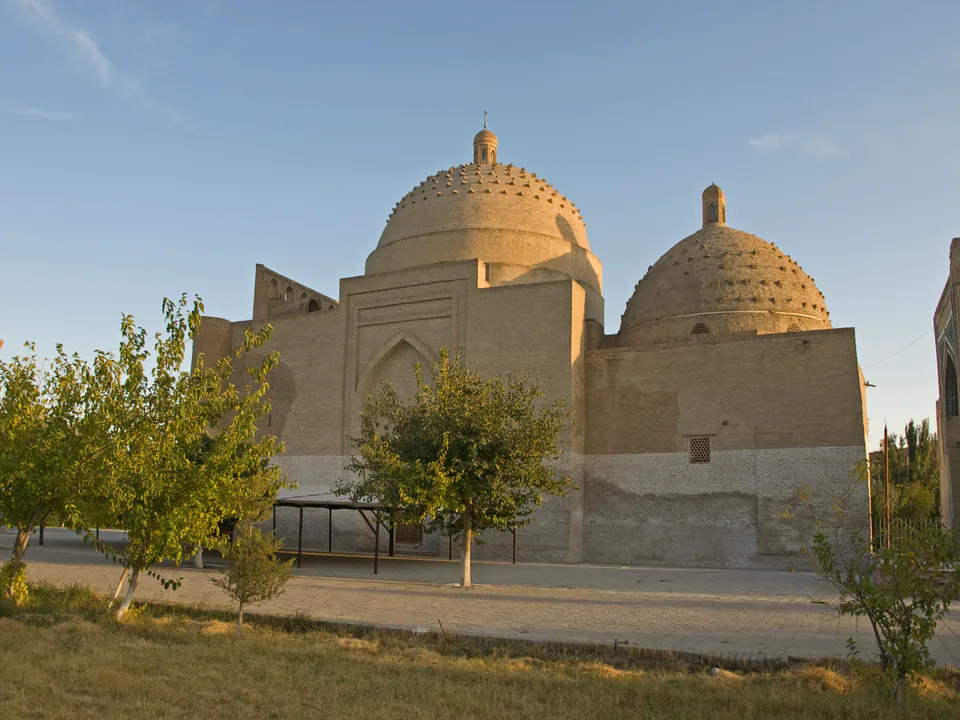
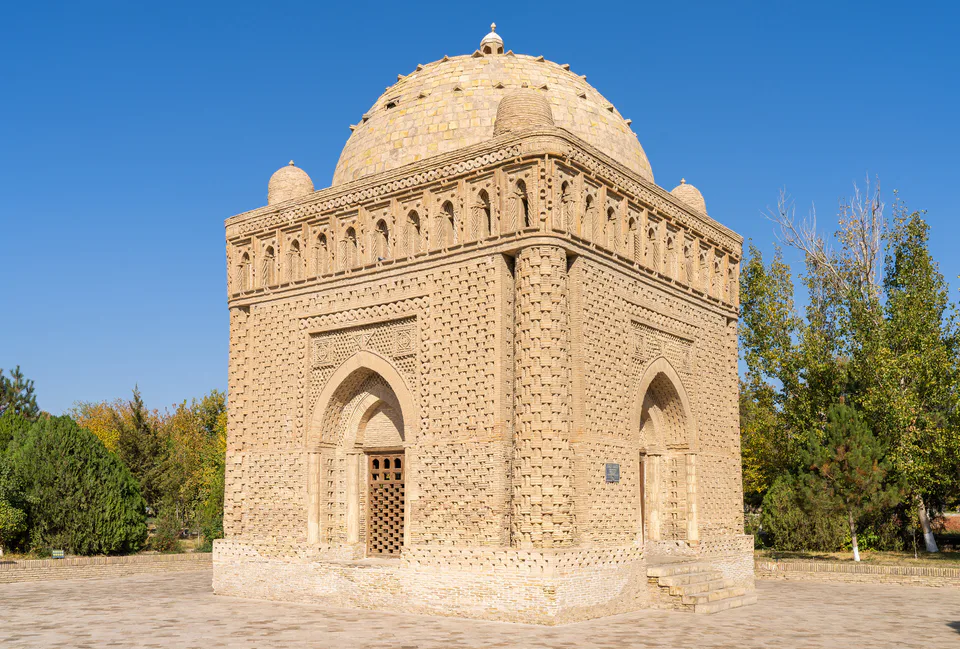
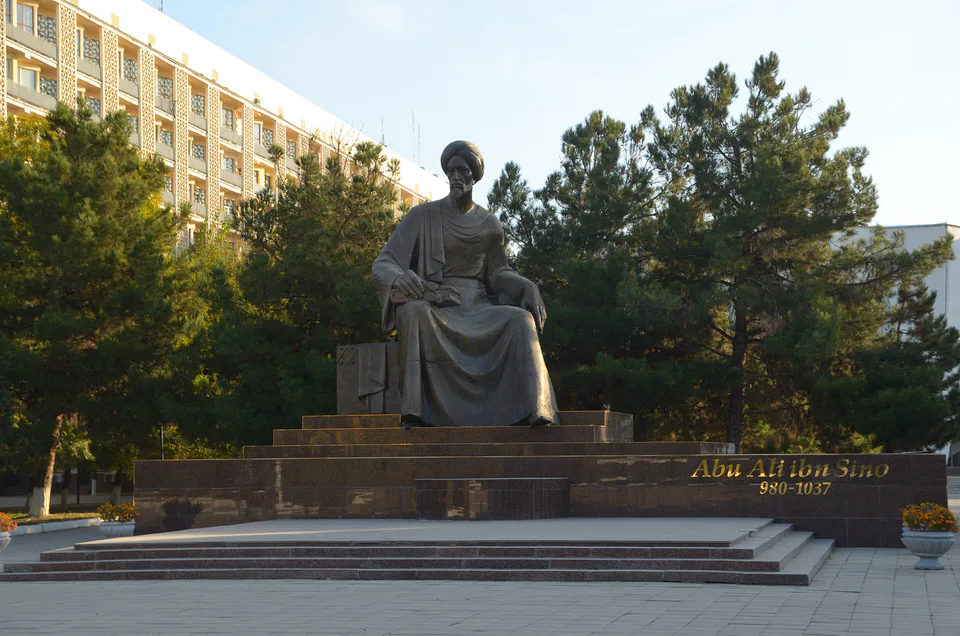
In 819 the grandsons of Saman Khuda were appointed governors of Samarkand, Fergana, Chach and Herat. From 892 Ismail Samani ruled from Bukhara, and in 900 he defeated the Saffarid Amr ibn al-Layth near Balkh, uniting Khurasan and Transoxiana. Nominally loyal to the Abbasids, the Samanids were independent in practice. Under them Bukhara and Samarkand became centres of learning: Persian poetry flourished with Rudaki, the young Ibn Sina studied in the Bukhara library, and Samarkand paper spread far and wide. The state fell to the Karakhanids in 999. Its best-known legacy is the Samanid Mausoleum in Bukhara.
In 999 Nasr ibn Ali of the Turkic Karakhanid dynasty seized Bukhara and brought the Samanid state to an end. The Karakhanids were among the first Turkic dynasties to embrace Islam; in the mid-11th century their realm split, and Samarkand became the seat of the Western khanate. Turkic now emerged as a literary language, with Yusuf Khass Hajib's poem “Kutadgu Bilig”. The Karakhanids were great builders: the Kalyan Minaret in Bukhara, the Rabati Malik caravanserai in Navoiy Region, and the minarets of Vabkent and Jarkurgan all date from their time. In the 12th century they became vassals of the Seljuks and then the Kara-Khitai, and in 1212 the Khwarazmshah Muhammad ended the dynasty.
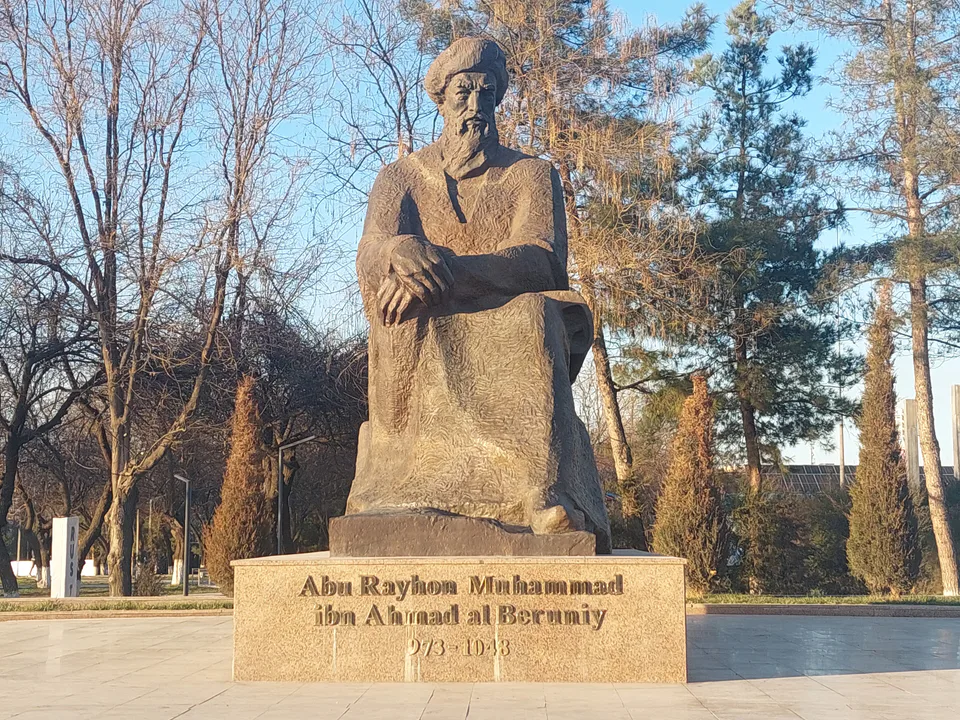
Around the turn of the 11th century a circle of outstanding scholars gathered at the court of the Khwarazmshah Ma'mun ibn Ma'mun in his capital Gurganj (today's Kunya-Urgench in Turkmenistan). Sources date its foundation to 1000 or 1004, and it is remembered as the Ma'mun Academy. Al-Biruni worked here, as did Ibn Sina for a time, the philosopher Abu Sahl al-Masihi and the mathematician Abu Nasr ibn Iraq. In 1017 Mahmud of Ghazni conquered Khwarazm and carried several scholars, al-Biruni among them, off to Ghazni. The academy was revived in Khiva in 1997, and its millennium was celebrated in 2006.
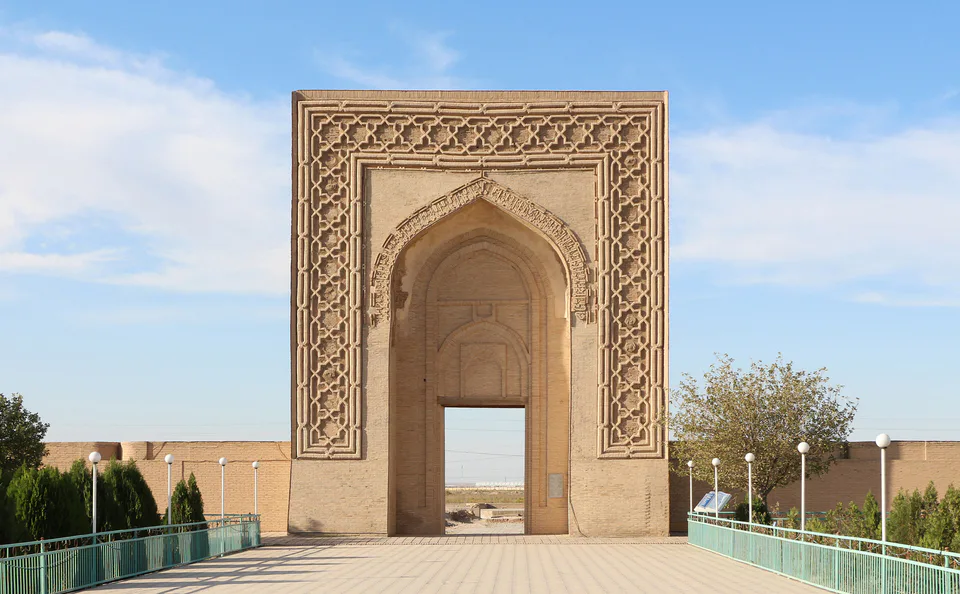
On the Samarkand–Bukhara road, in the Malik steppe of today's Navoiy Region, the Karakhanid ruler Shams al-Mulk Nasr (r. 1068–1080) built a palatial caravanserai. Barthold dated it to 1078–1079, though later research has questioned that date. From the 13th to the early 18th century it served as a caravan halt. What survives is the monumental portal facade, articulated by engaged columns, with an underground cistern, or sardoba, across the road. In 2023 Rabati Malik was inscribed on the UNESCO World Heritage List as part of “Silk Roads: Zarafshan-Karakum Corridor”.
The Seljuk governors of Khwarazm, the Anushteginid dynasty, took the title of Khwarazmshah from 1097 and gradually won independence. Tekish (1172–1200) defeated the last Seljuk sultan of Iraq in 1194, and his son Ala ad-Din Muhammad (1200–1220) wrested Transoxiana from the Kara-Khitai and in 1212 ended the Karakhanid dynasty in Samarkand. The empire reached from the Caspian to the Persian Gulf and from the Syr Darya to the Hindu Kush, and its capital Gurganj (Kunya-Urgench) became one of the richest cities of the Islamic world. Yet it was riven by internal feuds, and the Otrar incident of 1218 gave the Mongols their pretext for invasion. The last Khwarazmshah, Jalal ad-Din, died in 1231.
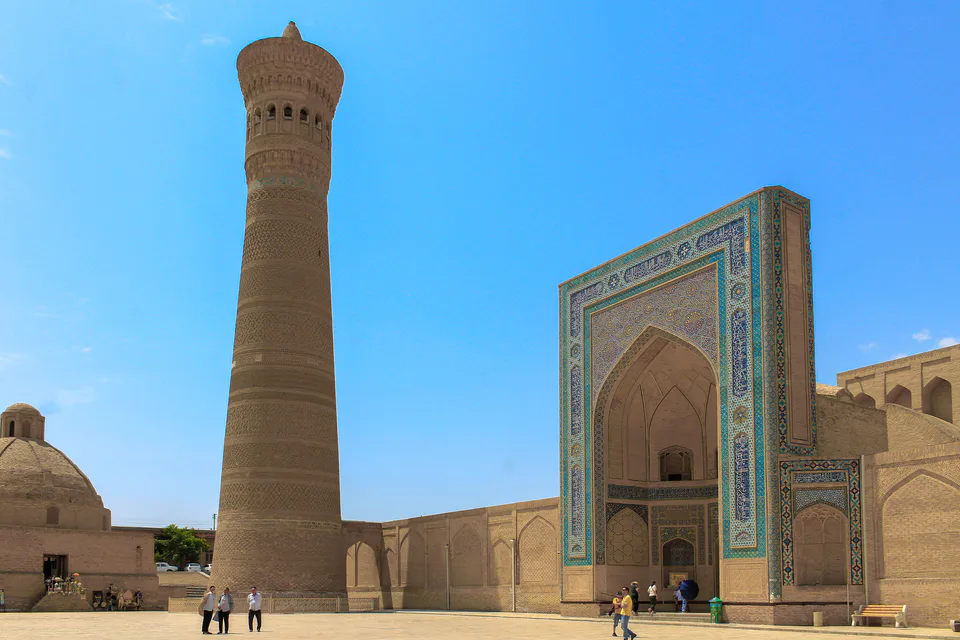
In 1127 the Karakhanid ruler Arslan Khan (Muhammad ibn Sulayman) built the Kalyan Minaret beside Bukhara's Friday mosque. Rising about 46 metres in fired brick, it is wrapped in alternating bands of patterned brickwork, and the arcaded lantern at the top served for the call to prayer and as a lookout. Its construction is linked to a master named Bako. Legend has it that Genghis Khan, who sacked Bukhara in 1220, was so struck by the tower that he ordered it spared. Today it anchors the Po-i-Kalyan ensemble and is the emblem of the Historic Centre of Bukhara, a UNESCO site since 1993.
Genghis Khan's invasion devastated the cities of Transoxiana, yet within a century life revived: the Chagatai Khanate, khans who embraced Islam, the Sufi orders and the rise of Timur.
In 1218 the governor of Otrar massacred a Mongol trade caravan, and Genghis Khan's envoys were then put to death; the outrage launched his campaign against the Khwarazmian Empire. Otrar was besieged in autumn 1219, Bukhara fell in February 1220 and Samarkand in March, Termez later that year, and the capital Gurganj in 1221 after a long siege. Cities were plundered, much of their population killed or enslaved, and irrigation works wrecked; the Sufi master Najm al-Din Kubra died among Gurganj's defenders. Shah Muhammad died on an island in the Caspian, while his son Jalal ad-Din fought on for another decade. Samarkand later moved from Afrasiyab to its present site.
After Genghis Khan's death in 1227, Transoxiana passed to the realm of his second son, Chagatai. The Mongol nobility stayed on the steppe and ruled the settled towns through governors such as the Khwarazmian merchant Mahmud Yalavach and his son Mas'ud Beg, who built a madrasa in Bukhara as cities slowly recovered. Kebek Khan (1318–1326) reformed the coinage and built a palace near Nakhshab; the city name Karshi is thought to derive from the Mongol word for palace. Under Tarmashirin in the 1330s the khans embraced Islam. By the mid-14th century the khanate had split into Moghulistan and a western half run by Turco-Mongol emirs — opening the way for Timur's rise.
In 1238 Mahmud Tarabi, a sieve-maker from the village of Tarab some 30 km from Bukhara, led a rising against Mongol rule and the local elite. Urban poor and peasants flocked to him; the rebels took Bukhara and seized the property of the rich. Tarabi was killed in battle with a Mongol army near Karmana, and the revolt was crushed. According to Juvayni, when the Mongols prepared to punish Bukhara, the governor Mahmud Yalavach saved its people from mass reprisals. It was the largest popular uprising in Transoxiana during the Mongol period.
Around 1333 the great Moroccan traveller Ibn Battuta crossed from the Golden Horde into Khwarazm. He described Urgench as one of the largest, finest and busiest cities of the Turks. He then went on to Bukhara, still largely in ruins after the Mongol conquest, and to Samarkand, which he praised as “one of the grandest and finest cities”, while noting its ruined walls. Near Nakhshab (Karshi) he visited the Chagatai khan Tarmashirin, a convert to Islam, before travelling via Termez to Afghanistan and India. His Rihla is a precious source on Mongol-era Central Asia.
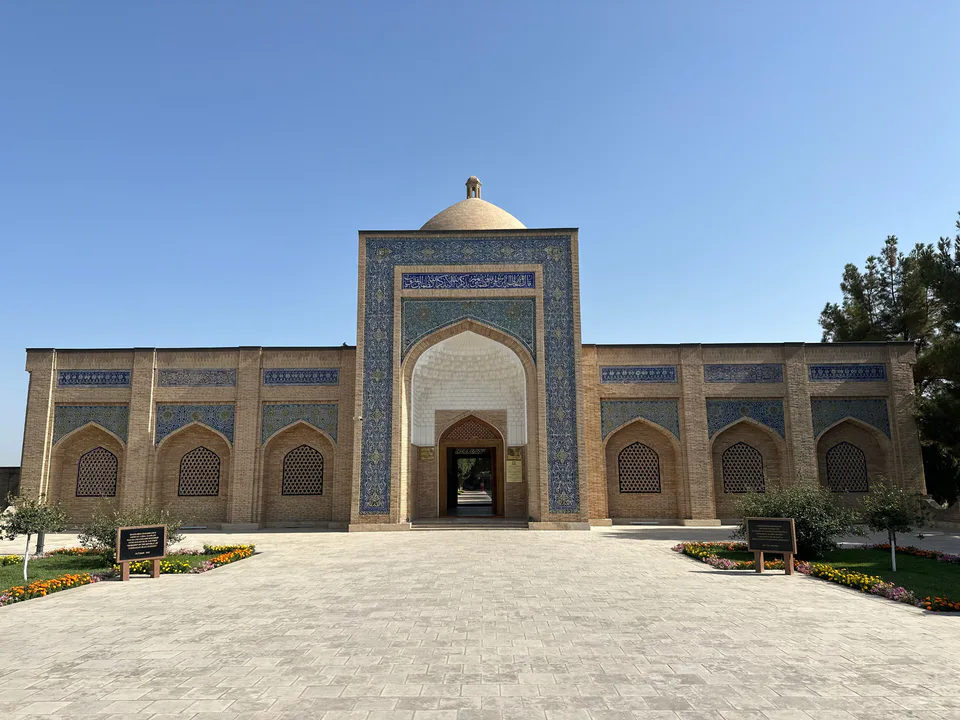
In the 14th century Baha al-Din Naqshband (1318–1389), who lived in the village of Qasr-i Hinduvan (later Qasr-i Arifan) near Bukhara, built on the Khwajagan path founded in the 12th century by Abdul Khaliq Gijduvani and gave his name to a new Sufi order. The Naqshbandiyya favoured silent remembrance of God and an upright life of work within society rather than withdrawal from it, an idea summed up in the saying “Dil ba yor, dast ba kor” — “the heart with God, the hands at work”. Under Khoja Ahrar in the 15th century the order became dominant in Transoxiana, later spreading to India, the Ottoman lands and the Caucasus. Bahauddin's memorial complex in Kagan district is one of Uzbekistan's most visited shrines.
The age of Timur and his descendants — a vast empire, the architectural masterpieces of Samarkand and Shakhrisabz, Ulugh Beg's observatory, Navoi's poetry and Babur's prose: the “Timurid Renaissance”.
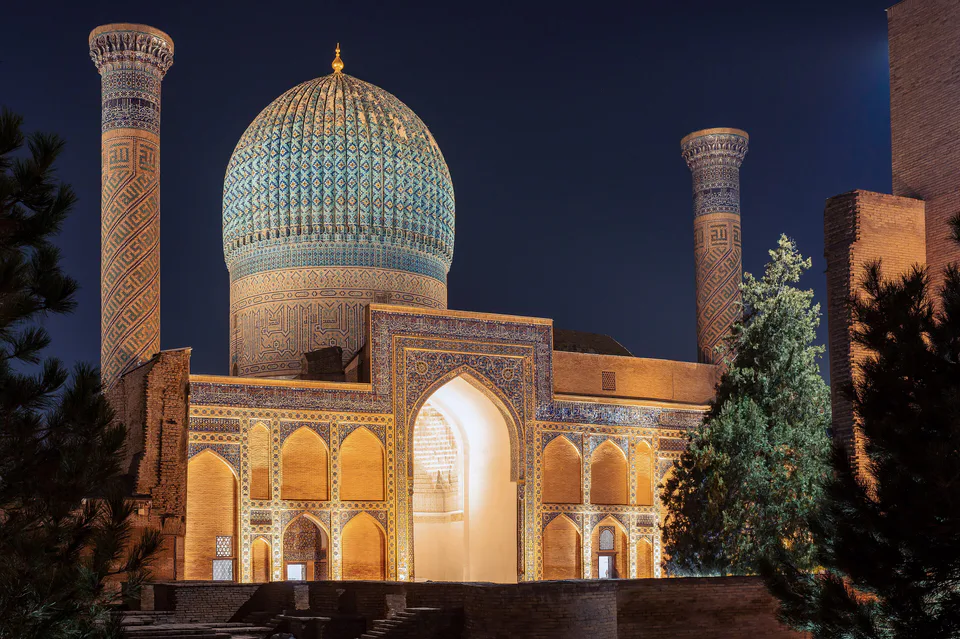
A Barlas emir from Kesh, Timur rose through the power struggles of Transoxiana in the 1360s, and in 1370 he defeated his former ally Amir Husayn at Balkh and was proclaimed supreme ruler by a kurultai. Marrying the Chinggisid princess Saray Mulk Khanum, he took the title gurkan, “royal son-in-law”, and made Samarkand his capital. Over the next 35 years he campaigned in Khwarazm, Iran, the Golden Horde, India, Syria and Anatolia, building a vast empire at the cost of many ruined cities and enormous loss of life. At the same time craftsmen from conquered lands were brought to Samarkand, Shakhrisabz and other towns, and the masterpieces of Timurid architecture took shape.
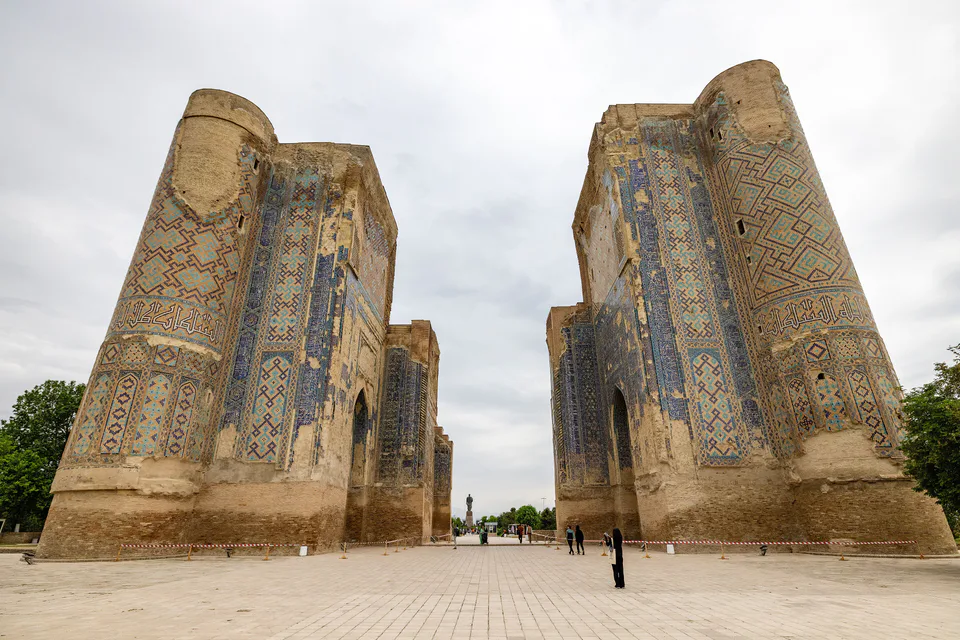
In 1380 Timur began building a vast summer palace, the Ak-Saray or “White Palace”, in his home town of Kesh, today's Shakhrisabz. Work went on for more than two decades: the Castilian envoy Clavijo, who came here in 1404, found it still unfinished and marvelled at halls adorned with gold and blue. The palace was later destroyed, and only the two colossal piers of its entrance arch survive, their height hinting at the scale of the lost portal. With the Kok Gumbaz mosque and the Dorus-Saodat and Dorut-Tilovat complexes, Ak-Saray forms the Historic Centre of Shakhrisyabz, a UNESCO World Heritage Site since 2000.
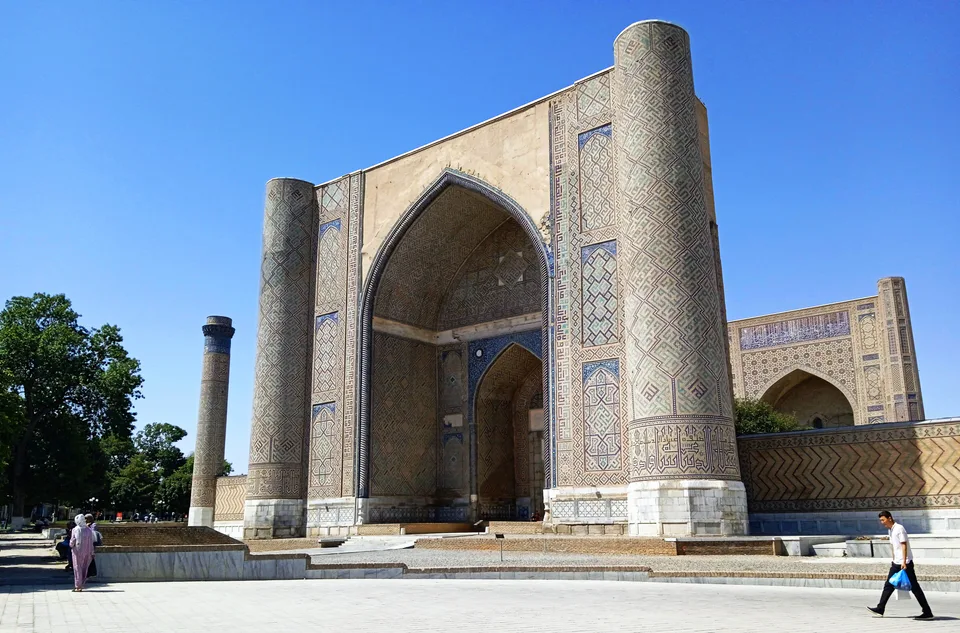
In 1404 Ruy González de Clavijo, envoy of King Henry III of Castile, travelled to the court of Timur. The embassy crossed the Amu Darya at Termez, passed through the Iron Gate gorge in the Baysun mountains and Kesh (Shakhrisabz), and reached Samarkand in September. Clavijo's journal describes receptions and feasts in the gardens around the city, its bazaars, the unfinished Ak-Saray and the Bibi-Khanym Mosque under construction. The envoys left in November; in February 1405 Timur died at Otrar. Clavijo's book remains one of the most vivid European accounts of Timurid Transoxiana.
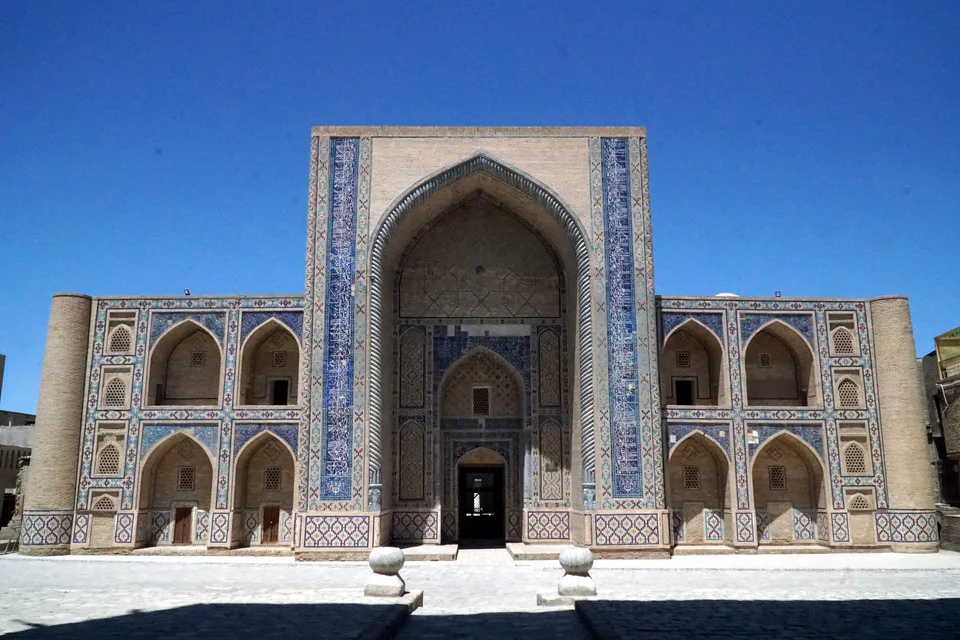
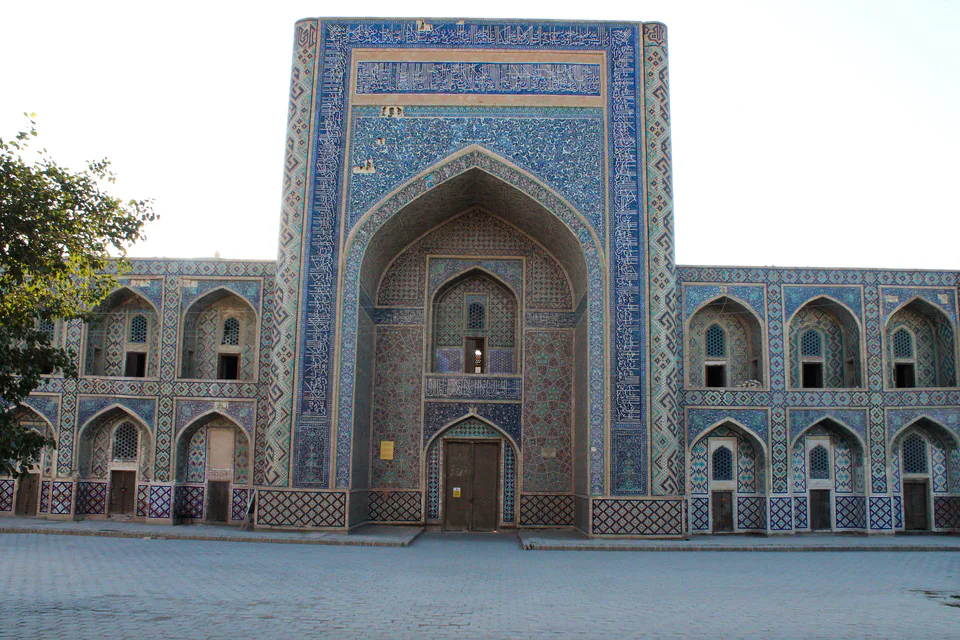
Mirzo Ulugh Beg, ruler of Samarkand, made learning a priority and founded three madrasas. The Bukhara madrasa of 1417 is among the oldest surviving in Central Asia; its door bears the hadith “The pursuit of knowledge is the duty of every Muslim man and woman.” The madrasa on Samarkand's Registan, built in 1417–1420, became a leading university of its age, teaching mathematics and astronomy alongside theology, and sources say Ulugh Beg lectured there himself. A third followed in Gijduvan in 1433. All three still stand and can be visited.
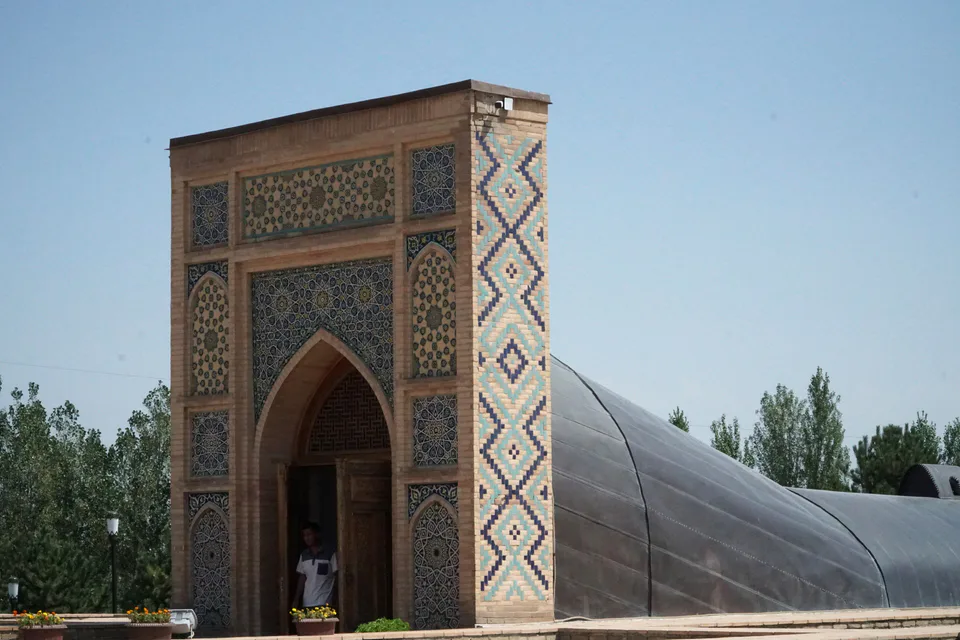
In 1424–1428 Mirzo Ulugh Beg built an observatory on the Kuhak (Chupan-Ata) hill outside Samarkand. Inside a three-storey cylindrical building about 46 metres across stood a giant sextant with a radius of over 40 metres, the largest astronomical instrument of its day. Jamshid al-Kashi, Qadi Zada al-Rumi, Ali Qushji and Ulugh Beg himself observed here, producing the Zij-i Gurgani, tables giving the positions of 1,018 stars. After Ulugh Beg's murder in 1449 the observatory was destroyed. In 1908 the archaeologist Vasily Vyatkin unearthed the underground section of the sextant, now covered by a museum.
Near Jizzakh the Sanzar river cuts a narrow gorge between the Malguzar and Nuratau ranges, long the route from the Samarkand oasis to the steppe. Nineteenth-century travellers called it the Gate of Tamerlane; locally it is Ilan-Uti. One Persian inscription carved into the rock records Mirzo Ulugh Beg's safe return from a campaign to the “land of the Moghuls” in 1425. Another, of 1571–1572, claims that Abdullah Khan's army routed “400,000” men from Turkestan, Tashkent and Fergana — a figure best taken as the author's boast. Today the Tashkent–Samarkand highway and railway run through the gorge.
In June 1494 Umar Shaikh Mirza, ruler of Fergana, was killed at the fortress of Akhsi when a dovecote on the edge of a ravine collapsed beneath him. His son Zahir ud-Din Muhammad Babur, born in Andijan in 1483, became ruler in Andijan at the age of eleven — the opening scene of the Baburnama. Years of struggle for Samarkand followed: Babur twice took the city briefly but lost out to Muhammad Shaybani Khan and left for Kabul in 1504. In 1526 his victory at Panipat founded the Mughal Empire in India. Andijan's Babur National Park holds the “Babur and World Culture” museum and a symbolic mausoleum of the poet.
The era of the Shaybanids and then of the khanates of Bukhara, Khiva and Kokand — madrasas and trading domes, the present faces of Itchan Kala and the Registan, and the poetry of Nodira, Mashrab and Ogahiy.
Muhammad Shaybani Khan, grandson of Abulkhayr Khan of the Uzbeks of the Dasht-i Kipchak, took Samarkand in 1500 and within a few years Bukhara, Tashkent, Fergana and, in 1507, Herat, ending Timurid rule. He fell in battle near Merv in 1510 against Shah Ismail of Iran, but his dynasty ruled Transoxiana until the end of the 16th century, first from Samarkand and then from Bukhara. Under the Shaybanids Bukhara gained the Mir-i Arab, Kukeldash and Abdullah Khan madrasas, trading domes and caravanserais, while cisterns and bridges were built across the country. The wide use of the name “Uzbek” in the region also dates from this period.
In 1511 Uzbek clans led by the Chinggisid brothers Ilbars and Balbars seized Khorezm and founded the Arabshahid dynasty. Its first capitals were Vazir and Kunya-Urgench, now in Turkmenistan; shifts in the course of the Amu Darya and politics led Arab Muhammad Khan (1602–1621) to move the capital permanently to Khiva. European sources have called the state the Khanate of Khiva ever since, though its people knew it as Khorezm. It spanned the irrigated lands of the lower Amu Darya, the Turkmen tribes of the Karakum and the Karakalpaks of the Aral shore. It became a Russian protectorate in 1873 and lasted until 1920.
The Shaybanid Abdullah Khan II seized Bukhara in 1557, made it his capital and became khan in name as well from 1583. He reunited the fragmented realm, bringing Balkh, Herat, Tashkent, Fergana and, briefly in the 1590s, Khorezm under his rule. To boost trade he lined the roads with caravanserais, cisterns and bridges. In Bukhara his era produced the paired Kosh Madrasah (Modarikhan, c. 1567, and Abdullah Khan, 1588–1590), the Tim of Abdullah Khan, Toki Zargaron and other trading domes, and the Chor-Bakr necropolis. The poet Mushfiqi and the historian Hafiz Tanysh Bukhari worked at his court. After his death in 1598 the dynasty swiftly declined.
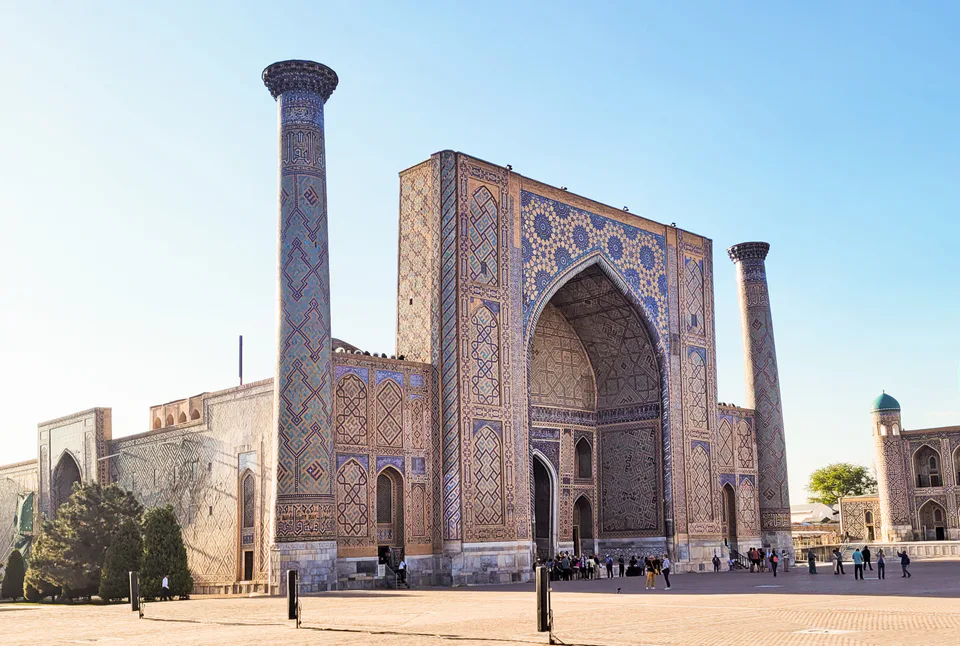
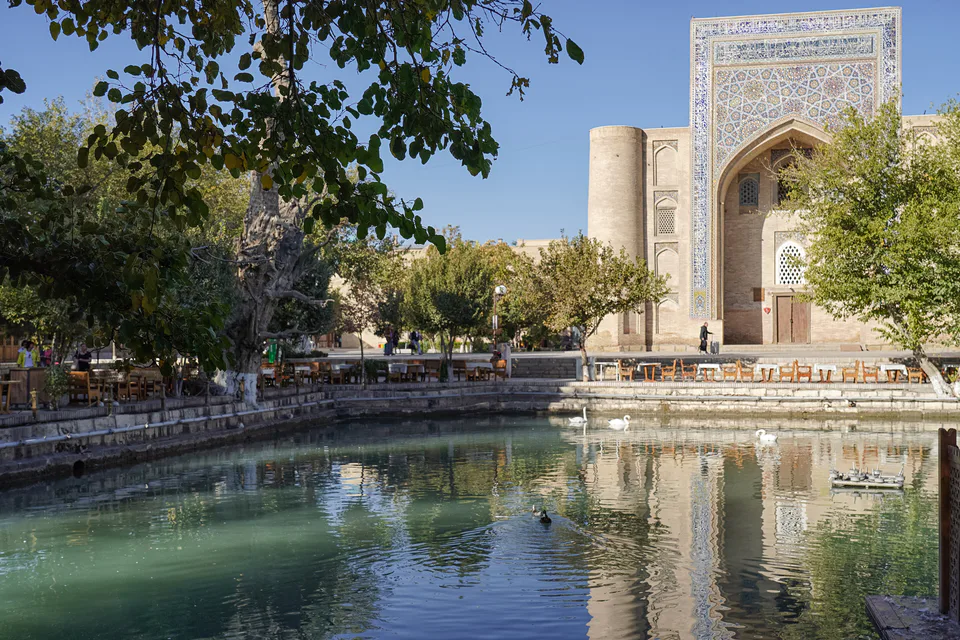
In the early 17th century power passed to the Ashtarkhanid (Janid) dynasty, whose officials left major buildings behind them. In Bukhara, Nadir Divan-Begi, vizier of Imam Quli Khan, dug a pool in 1620 and built a khanaka beside it, followed in 1622 by a madrasa first intended as a caravanserai — the origin of Lyab-i Hauz, still the city's favourite square. In Samarkand the governor Yalangtush Bahadur remade the Registan: facing Ulugh Beg's madrasa rose the Sher-Dor Madrasa (1619–1636) with lions and suns on its portal, and later the gilded Tilya-Kori madrasa-mosque (1646–1660), giving the ensemble its present form.
In 1709 Shahrukh Biy, chief of the Uzbek Ming tribe, took advantage of Bukhara's weakness to set up independent rule in the Fergana Valley — the beginning of the Khanate of Kokand. In 1740 Abd al-Karim Biy built a new fortress on the ruins of Eski Urda, and Kokand quickly grew into a capital. Alim Khan (1798–1810) adopted the title of khan and took Tashkent in 1809; under Umar Khan (1810–1822) court literary life flourished, with the poets Nodira and Uvaysiy. The khanate stretched along the Syr Darya into today's Kazakhstan and Kyrgyzstan. In 1876 Russia abolished it and created Fergana Oblast in its place.
Returning from his invasion of India, the Iranian ruler Nader Shah crossed the Amu Darya in 1740 and advanced on Bukhara. The Ashtarkhanid Abulfayz Khan submitted without a fight and kept his throne, but real power began to pass to Nader's ally, the Manghit emir Muhammad Hakim Biy, and his son Muhammad Rahim Biy. That same year Nader marched on Khiva, where Ilbars Khan, who had resisted, was executed; the khanate remained under Iranian sway until 1746. The campaign hastened the fall of the Ashtarkhanids and opened the way for the Manghits. After Nader's assassination in 1747, Iranian influence faded.
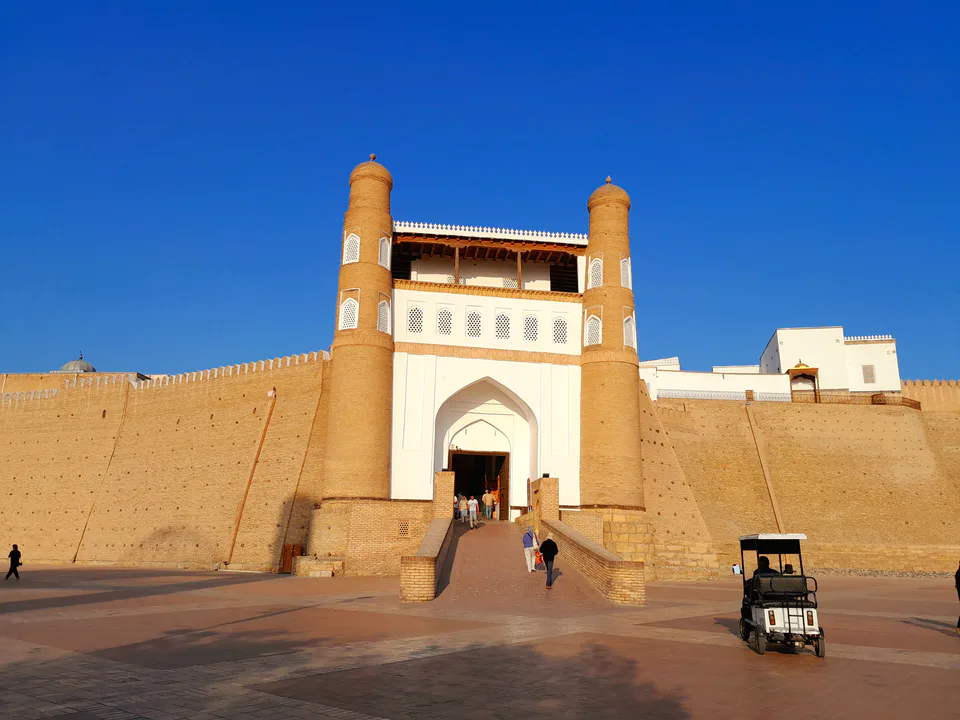
In 1756 Muhammad Rahim Biy of the Manghit tribe assumed the title of khan in Bukhara and founded a new dynasty. Shah Murad (Masum), who came to power in 1785, dropped the khan title in favour of “emir al-muminin”, which is why the state is known as the Emirate of Bukhara. It covered the Zeravshan, Kashkadarya and Surkhandarya oases and much of present-day Tajikistan. The emirs lived in the Ark fortress, and under Nasrullah (1827–1860) central power grew stronger. From 1868 the emirate was a Russian protectorate. Sitorai Mohi Khosa, the palace built for the last emir, Alim Khan, is now a museum. The emirate was overthrown in 1920.
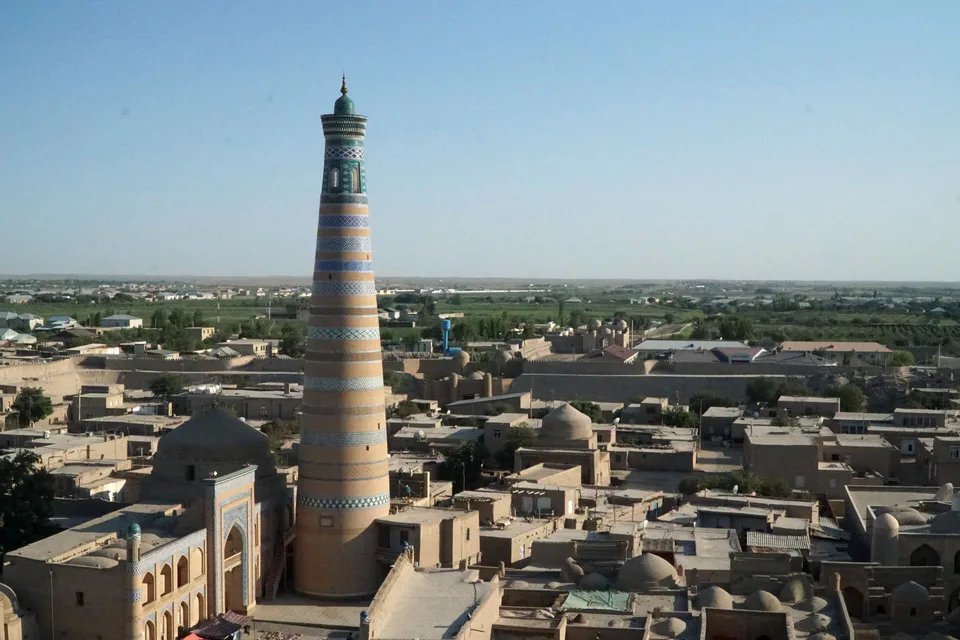
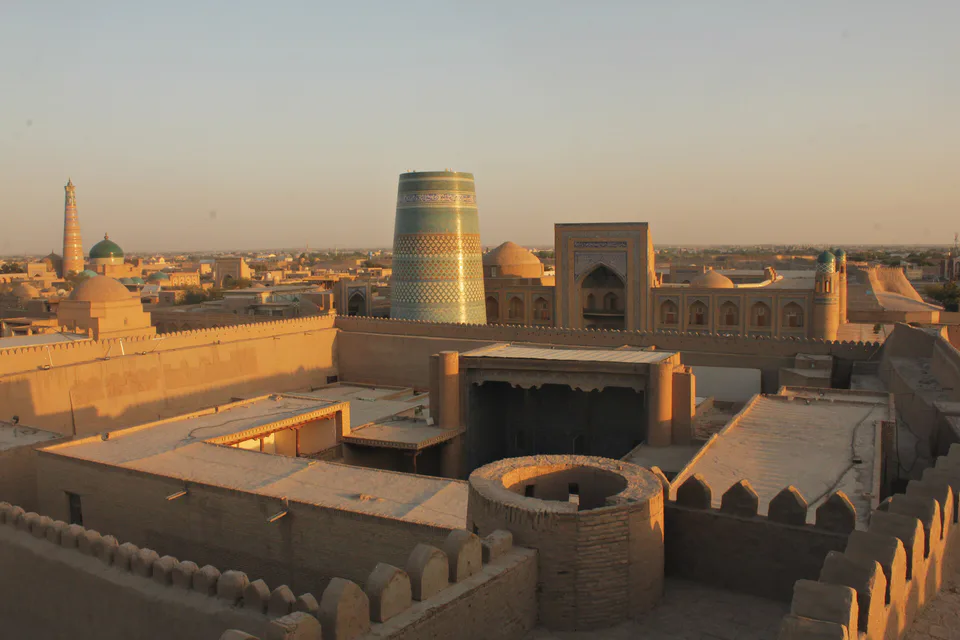
In 1804 Eltuzar of the Qungrat tribe took the title of khan, founding Khiva's last dynasty. The 19th century was Itchan Kala's great building age: under Allakuli Khan came the Tash Hauli palace (1830–1838) and his madrasa and caravanserai, and in 1842 the outer town, Dishan Kala, was walled. The Kalta Minor beside the Muhammad Amin Khan Madrasa (1851–1855) was left unfinished when the khan was killed. The madrasa of Muhammad Rahim Khan II followed in 1871 and, in 1908–1910, the Islam Khoja madrasa and Khiva's tallest minaret. Itchan Kala is thus largely 18th–19th-century architecture; it joined the UNESCO list in 1990.
In the 19th century the British and Russian empires competed for influence in Central Asia, a rivalry known as the Great Game. In December 1838 the British officer Charles Stoddart arrived in Bukhara to negotiate with Emir Nasrullah, but was arrested and held for years in the city's prison. Arthur Conolly, who came in 1841 to secure his release, was imprisoned too. In June 1842 both were executed as spies in the square before the Ark. The missionary Joseph Wolff, who travelled to Bukhara to learn their fate, published an account in 1845 that made the story famous in Europe. Bukhara's Zindan museum shows the pit in which prisoners were kept.
The Governorate-General of Turkestan, the protectorates of Bukhara and Khiva, railways and cotton, new Russian towns and the Jadid movement — the colonial era transformed life in the region.
From 9 May to 17 June 1865 General Mikhail Chernyayev's troops besieged Tashkent, then part of the Khanate of Kokand. Alimqul, Kokand's de facto ruler, was killed leading the defence, and the city passed to the Russian Empire. In 1866, at war with the Emirate of Bukhara, Russian forces took Khujand, Ura-Tyube and Jizzakh. In 1867 the Governorate-General of Turkestan was created with its seat in Tashkent, headed first by General Konstantin von Kaufman. A new European-style Russian town grew up beside the old city, and Tashkent became the region's administrative centre.
Samarkand falls and Bukhara becomes a protectorate
In May 1868 Kaufman's troops defeated the army of Emir Muzaffar of Bukhara on the Chupan-Ata heights and entered Samarkand. In June, while the main force crushed the emir again at Zirabulak, the small garrison left in Samarkand's citadel was besieged by townspeople and the forces of the Shakhrisabz begs; among the defenders was the painter Vasily Vereshchagin. Under the peace signed at the end of June, Samarkand and Kattakurgan passed to Russia as the Zeravshan District, and the Emirate of Bukhara became a Russian protectorate. Vereshchagin's Turkestan series, including scenes of the siege, hangs in Moscow's Tretyakov Gallery.
In spring 1873 several Russian columns under the overall command of General Kaufman crossed the deserts from different directions into Khorezm, and at the end of May Khiva surrendered without a fight. Under the Treaty of Gandimian, signed in August, Muhammad Rahim Khan II kept his throne but lost the right to conduct foreign policy without Russian consent; the slave trade and slavery were abolished and a heavy indemnity imposed. The right bank of the Amu Darya, most of today's Karakalpakstan, passed to Russia as the Amu Darya Department, administered from the fort of Petro-Alexandrovsk, now Turtkul. Khiva survived as a protectorate until 1920.
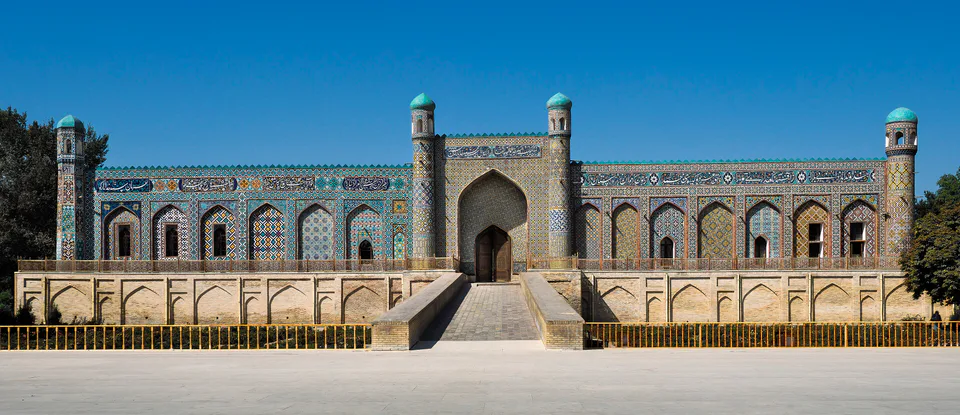
In 1873 a broad revolt against Khudayar Khan's heavy taxes swept the Fergana Valley, led by a pretender known as Pulat Khan. In 1875 Khudayar was overthrown and fled to Russian territory, and the rising turned against Russia. Troops under General Kaufman and Mikhail Skobelev occupied the valley, and in February 1876 an imperial decree abolished the khanate, replacing it with Fergana Oblast. A new administrative centre, New Margelan, was built — later renamed Skobelev and, from 1924, Fergana. Khudayar Khan's palace in Kokand now houses the regional museum.
Built eastward from the Caspian shore under General Mikhail Annenkov, the Trans-Caspian Railway reached Samarkand via Bukhara (Kagan) in 1888. Trains first crossed the Amu Darya on a wooden bridge; a permanent one was completed only in 1901. In 1898 the line was extended to Tashkent and Andijan, and the opening of the Tashkent–Orenburg railway in 1906 linked Central Asia directly with central Russia. The railway boosted cotton exports dramatically, and new settlements grew around stations such as Kagan and Khavast and in the Russian quarters of towns like Jizzakh. The old station buildings of Kagan and Samarkand recall the era.
On the night of 29 May 1898 some 1,500 armed men led by the Naqshbandi sheikh Muhammad Ali Madali, known as Dukchi Ishan, attacked the Russian army camp at Andijan. The rising fed on resentment of colonial rule, taxation and land policy, as well as on religious appeals. The troops quickly recovered and beat off the attack, and within days the revolt was crushed. Dukchi Ishan and other leaders were executed, many participants exiled and their villages punished. The episode pushed the authorities to tighten control over Muslim institutions in Turkestan.
In the late 19th and early 20th centuries a reform movement took shape in Turkestan: the Jadids, advocates of usul-i jadid, the “new method”. Inspired by the Crimean Tatar educator Ismail Gasprinsky, Mahmudkhoja Behbudiy, Munavvar Qori, Abdulla Avloniy, Is'hoqxon Ibrat, Abdurauf Fitrat and others opened schools teaching literacy by the phonetic method and wrote textbooks. From 1906 Uzbek-language newspapers such as Taraqqiy and Khurshid appeared in Tashkent, and Behbudiy's play “The Patricide” (Padarkush), staged in 1914, launched a national theatre. The Jadids sought to renew society through education, the press and reform. Many were repressed in the 1920s–1930s; their legacy is being rediscovered today.
On 25 June (8 July) 1916, at the height of the First World War, Nicholas II decreed the conscription of Turkestani men aged 19 to 43 for labour behind the front. Issued at harvest time and enforced through unfair lists, the decree provoked mass unrest. In July there were protests in Khujand, Tashkent and towns of the Fergana Valley; in Jizzakh the rising turned into armed fighting and was crushed with great brutality by punitive detachments, which left the old town badly damaged. The revolt also spread across Kazakhstan and Kyrgyzstan. Tens of thousands of labourers were eventually sent to the front zone regardless.
Revolution and armed struggle, the birth of the Uzbek SSR, collectivisation and purges, the war years, industrialisation and the cotton monoculture — 74 years full of contradictions.
After the October Revolution of 1917, power in Tashkent passed to a Bolshevik-led soviet that excluded the local Muslim majority. In response, the Fourth Extraordinary Congress of Turkestan Muslims, meeting in Kokand on 27 November 1917, proclaimed a Turkestan Autonomy within a Russian federation. Its government was led by Mukhamedzhan Tynyshpaev and then Mustafa Chokay, with Jadids among its members. In February 1918 Red Guard units sent from Tashkent stormed Kokand; much of the city was destroyed and thousands of civilians were killed. Short-lived as it was, the autonomy is seen as a milestone in the region's pursuit of national statehood.
After the Turkestan Autonomy was crushed, an armed movement against Soviet rule spread through the Fergana Valley from 1918. Soviet sources called it the Basmachi movement; Uzbek historians today more often describe it as a struggle for independence. It was led by local commanders, or kurbashi, such as Ergash, Madamin Bek and Shermuhammad Bek (Kurshermat). After 1920 the fighting shifted to Eastern Bukhara and the mountains of Kashkadarya and Surkhandarya, where Ibrahim Bek was a leading figure; the Ottoman general Enver Pasha joined in 1921–1922 and was killed in 1922. Large Red Army forces had largely suppressed the movement by the mid-1920s, though isolated bands held out into the early 1930s.
In February 1920 the Red Army and Young Khivan forces ended the Khanate of Khiva: the last khan, Said Abdullah, abdicated, and in April the Khorezm People's Soviet Republic was proclaimed. On 2 September 1920 the Red Army under Mikhail Frunze, together with the Young Bukharans, took Bukhara after a bombardment that set the Ark and parts of the city ablaze; Emir Alim Khan fled to Eastern Bukhara and in 1921 to Afghanistan. In October the Bukharan People's Soviet Republic was created, headed by Fayzulla Khodjaev, with Fitrat among its ministers. Both republics were dissolved in the national delimitation of 1924.
In 1924 Central Asia underwent national-territorial delimitation: the Turkestan ASSR and the Bukharan and Khorezm republics were replaced by new republics drawn largely along ethnic lines. On 27 October 1924 the Uzbek Soviet Socialist Republic was formed, with the Tajik ASSR inside it until 1929. Its First Congress of Soviets met in Bukhara in February 1925. Samarkand was the first capital; in 1930 the capital moved to Tashkent. The borders drawn then largely define today's Uzbekistan, but in mixed areas such as the Fergana Valley they left complicated frontiers and enclaves.
On 8 March 1927, International Women's Day, the Soviet authorities launched the Hujum (“assault”) campaign in Central Asia. It aimed to persuade women to give up the paranja robe and horsehair veil and to change their status through literacy classes and work outside the home, with mass veil-burnings staged in city squares. The campaign met fierce resistance: many unveiled women were harassed, and by some estimates around 2,500 were murdered. Historians judge the Hujum in different ways — as a reform that opened education and careers to women, and as a coercive policy that cost many lives.
After the national delimitation, in 1925 a Karakalpak Autonomous Oblast was created on the lands of the lower Amu Darya, first within the Kazakh ASSR and from 1930 directly under the Russian SFSR. On 20 March 1932 it became the Karakalpak Autonomous Soviet Socialist Republic, the only ASSR in Soviet Central Asia. On 5 December 1936 it was transferred to the Uzbek SSR. Its first capital, Turtkul, was threatened by the eroding Amu Darya, so in 1939 the capital moved to Nukus. The republic declared sovereignty in 1990; today it is the Republic of Karakalpakstan within Uzbekistan.
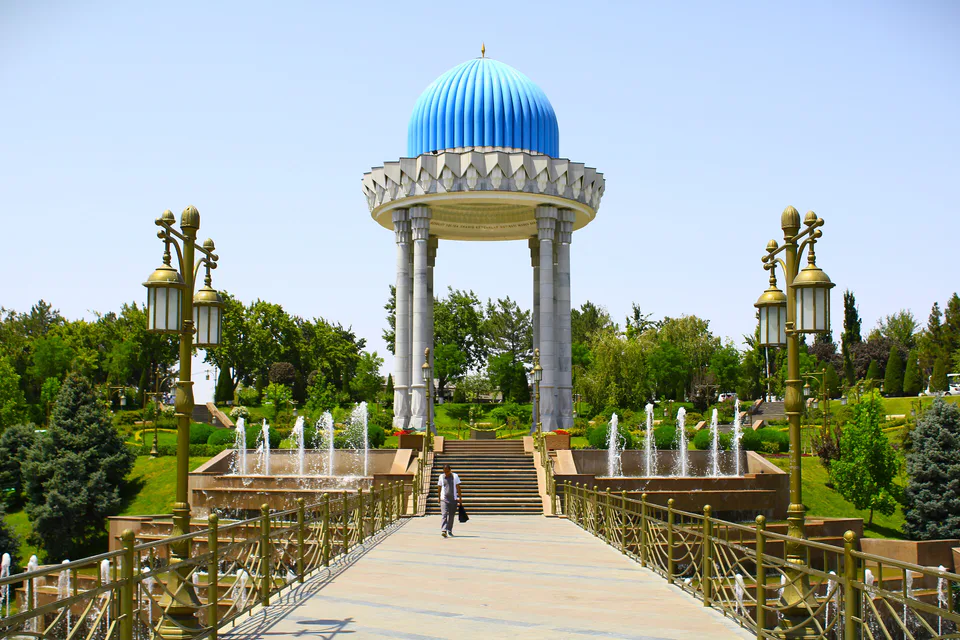
In the 1930s Uzbekistan saw campaigns of “dekulakisation” and against clergy and “nationalists”, culminating in the Great Terror of 1937–1938. The republic's first leaders, Fayzulla Khodjaev and Akmal Ikramov, were shot in Moscow in March 1938. On the night of 4–5 October 1938 the writers Abdulla Qodiriy, Cho'lpon, Fitrat and many other intellectuals were executed in Tashkent. Tens of thousands were arrested, deported or shot; most were rehabilitated from the late 1950s. At the burial site in Tashkent's Yunusabad district stand the Shahidlar Xotirasi memorial and the Museum of Victims of Repression.
In summer 1939 work began on the 270-kilometre Great Fergana Canal. Through hashar, communal voluntary labour, some 160,000 collective farmers, mostly Uzbek and Tajik, were mobilised, and the canal was dug — largely with ketmen hoes and hand barrows — in 45 days. Carrying water from the Naryn and Kara Darya across the valley, it opened new land and expanded cotton fields, with more than a thousand hydraulic structures along its course. Soviet propaganda made it a symbol of collective effort; its pace and harsh conditions were later viewed more critically. It remains the valley's main irrigation artery.
Between 1941 and 1945, by various estimates, 1.5 to 2 million people from Uzbekistan went to the front, and more than 500,000 never returned. Over 300 natives of the republic were made Heroes of the Soviet Union. Uzbekistan became a rear base: dozens of factories, research institutes, theatres and hundreds of thousands of evacuees, many of them orphaned children, arrived from the west. The Tashkent blacksmith Shoahmad Shomahmudov and his wife Bahri became famous for adopting orphans of many nationalities — between 14 and 16, according to different sources. The war turned Tashkent into an industrial centre, while the countryside endured gruelling work and shortages.
Efforts to irrigate the waterless Hungry Steppe (Mirzachul) on the left bank of the Syr Darya began in the late 19th century: a canal named after Nicholas I opened in 1895, and Grand Duke Nikolai Konstantinovich dug channels and founded villages for Russian settlers. Large-scale development came in the 1950s and 1960s: in 1956 part of the steppe was transferred from the Kazakh SSR to Uzbekistan, the Kirov Northern canal was rebuilt and new Central and South Hungry Steppe canals were dug. Some 800,000 hectares of new cotton land appeared, along with Gulistan, Yangiyer and dozens of state-farm villages. Syrdarya Region was created in 1963. Soil salinisation later became a serious problem.
In 1958 geologists discovered a giant gold deposit in the Muruntau hills of the south-western Kyzylkum; the team won the Lenin Prize in 1966. Industrial mining began in 1969, creating one of the world's largest open-pit gold mines, some 3.5 km long and about 600 metres deep. The city of Navoiy was founded near Karmana the same year as the discovery, and desert towns such as Uchkuduk and Zarafshan grew up around the Navoi Mining and Metallurgical Combine. Navoiy Region was created in 1982 (temporarily abolished in 1988–1992) and is today one of Uzbekistan's main industrial regions.
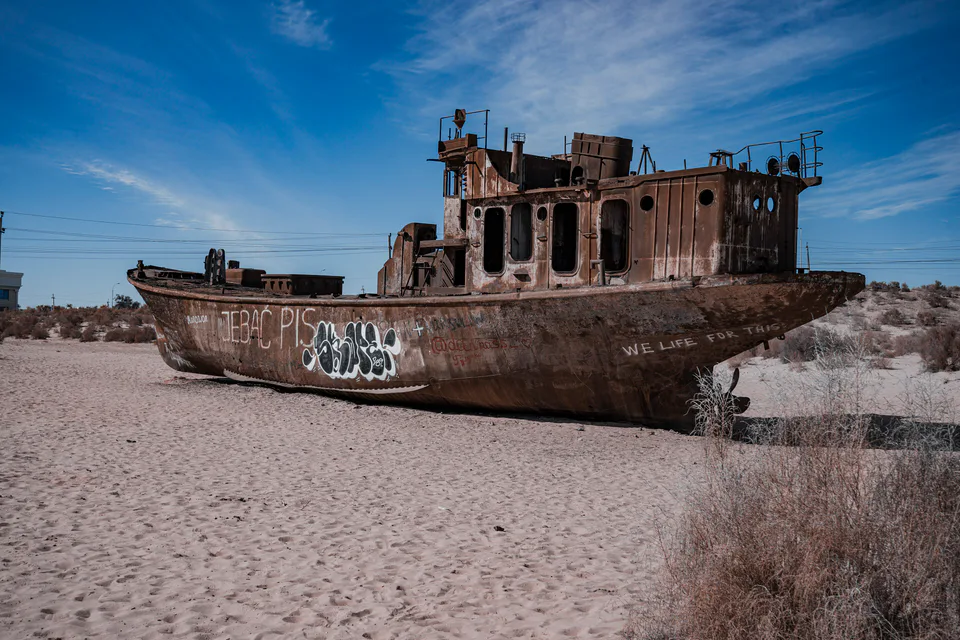
Once covering 68,000 km² and among the largest lakes on Earth, the Aral Sea began to shrink in the 1960s, when the waters of its feeder rivers, the Amu Darya and Syr Darya, were diverted to irrigate cotton. By 2007 it had fallen to about 10% of its former area and split into several lakes, leaving behind the new Aralkum desert. Moynaq, once a busy fishing port, now lies tens of kilometres from the water, with a “graveyard” of rusting ships on the sand. Salt and dust storms have seriously affected public health. UN Secretary-General Ban Ki-moon called it one of the planet's worst environmental disasters.
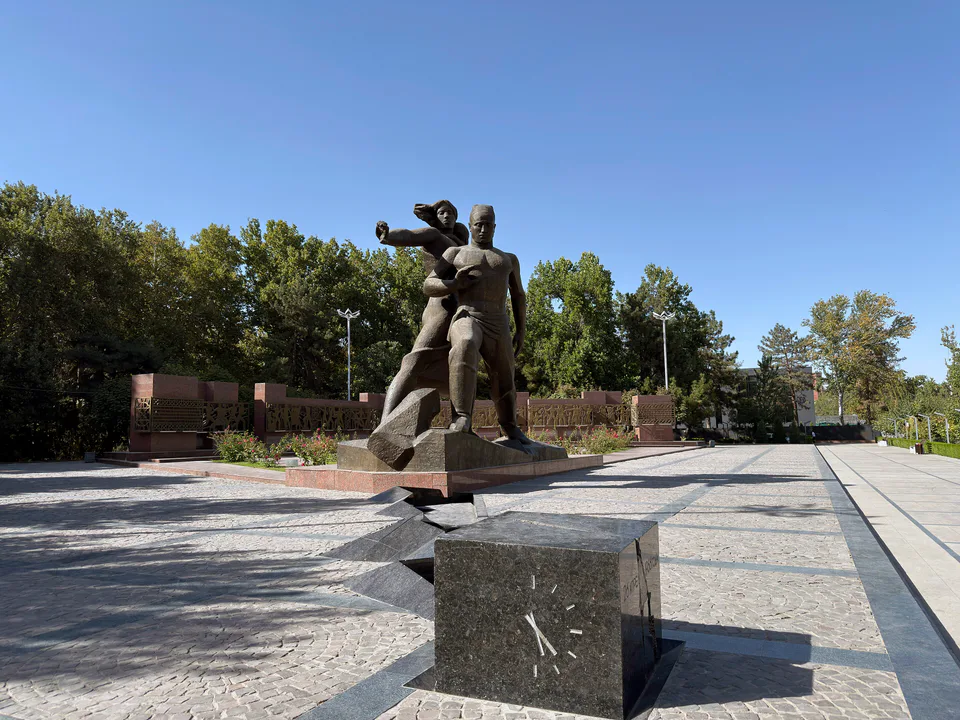
Early on 26 April 1966 a powerful earthquake of magnitude 5.2 struck directly beneath central Tashkent at a depth of only 3–8 km. It destroyed much of the old housing in the centre and left 200,000–300,000 people homeless; the official death toll was 15, though other estimates are far higher. Builders from across the Soviet Union rebuilt the city, and within a few years new housing districts and broad avenues gave Tashkent its Soviet-modernist face. In 1977 Central Asia's first metro opened. The Courage Monument has marked the epicentre since 1976.
During perestroika interest in the national language, history and culture surged. On 21 October 1989 the Supreme Soviet of the Uzbek SSR passed the Law on the State Language, making Uzbek the state language while Russian kept its role as the language of inter-ethnic communication. The law widened the use of Uzbek in administration, education and the press, and became a key symbol of the national revival on the eve of independence. Since 2019, 21 October has been celebrated as Uzbek Language Day. In the same years victims of the purges were rehabilitated, and the works of Qodiriy, Cho'lpon and Fitrat were published again.
Since 1991 Uzbekistan has been an independent state: a constitution and national symbols, the revival of historic heritage, reforms after 2016 and an opening to international tourism.
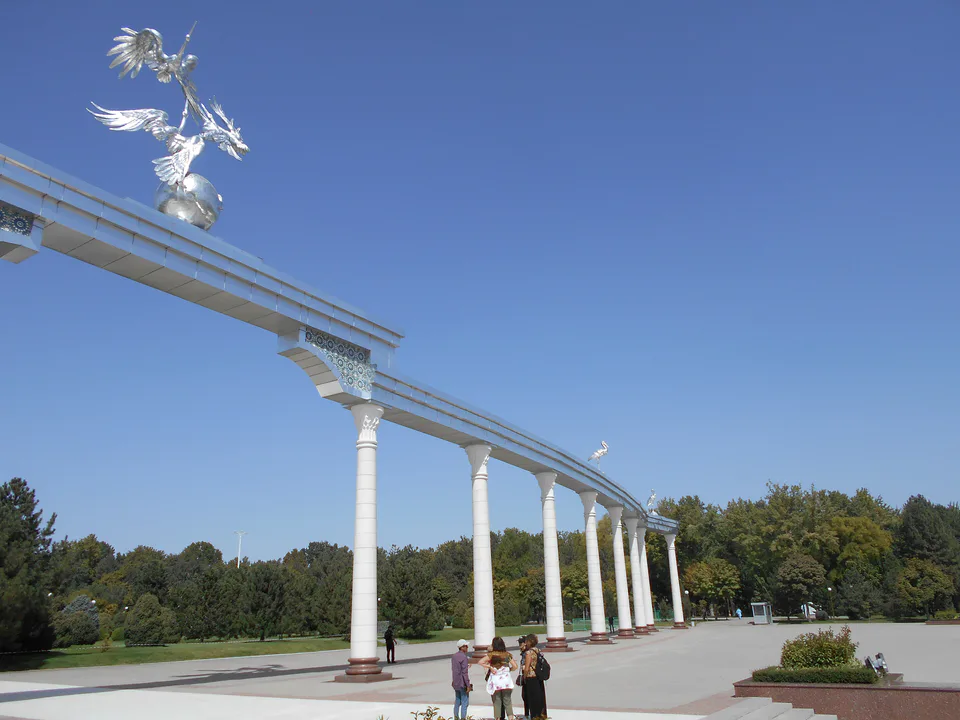
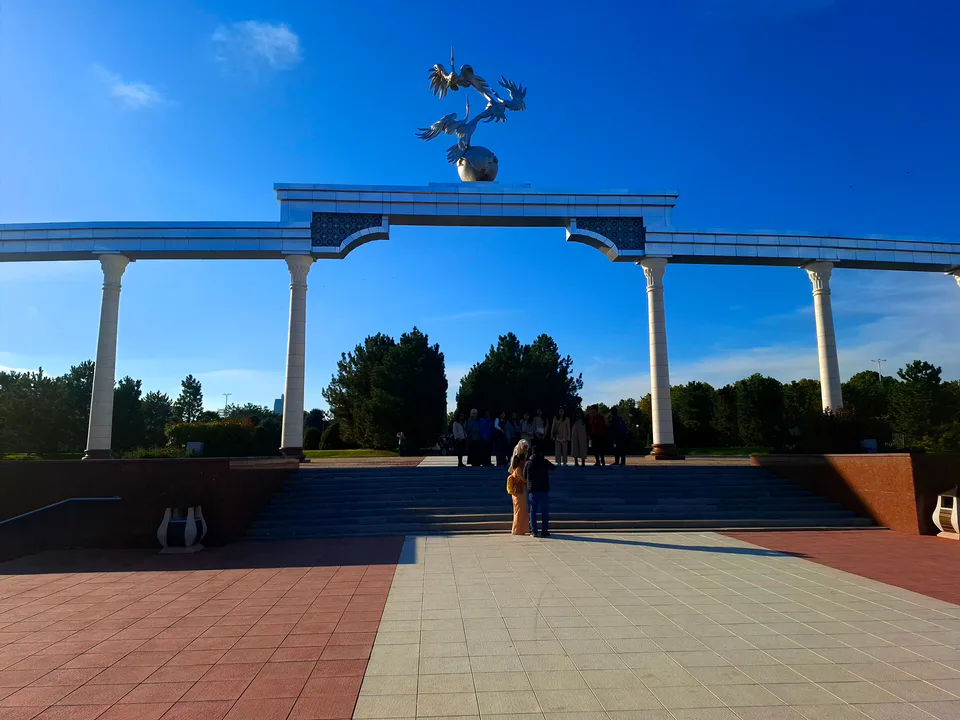
After the failed August coup in Moscow, on 31 August 1991 the Supreme Council of the Republic of Uzbekistan declared state independence, and 1 September became Independence Day. The national flag was adopted on 18 November 1991. In a referendum on 29 December more than 98% of voters backed independence, and Islam Karimov was elected president the same day. Uzbekistan joined the United Nations on 2 March 1992, and on 1 July 1994 the national currency, the sum, came into circulation. Tashkent's former Lenin Square became Mustaqillik (Independence) Square, the country's main square.
On 8 December 1992, at the eleventh session of the Supreme Council, the Constitution of the Republic of Uzbekistan was adopted. With 128 articles, it proclaimed Uzbekistan a sovereign democratic republic and enshrined the separation of powers and human rights and freedoms; 8 December is marked as Constitution Day. The national symbols were completed that year too: the coat of arms was approved on 2 July and, on 10 December, the national anthem with lyrics by Abdulla Oripov and music by Mutal Burhanov. The constitution was amended several times and adopted in a new edition in 2023.
Uzbek changed its script three times in the 20th century: from Arabic to Latin in 1929 and to Cyrillic in 1940. On 2 September 1993 a law introduced a Latin-based Uzbek alphabet, revised on 6 May 1995 into its current form, with the letters oʻ and gʻ and the digraphs sh, ch and ng. Schools began teaching in Latin script in the late 1990s, and the deadline for the full transition has been extended several times. Today official documents and street and road signs are mostly in Latin script, while Cyrillic remains common in everyday life and the press.
1993
Itchan Kala
1990–2026
Uzbekistan's UNESCO World Heritage Sites
Uzbekistan joined the World Heritage Convention in January 1993. The first site, inscribed while still in Soviet times in 1990, was Itchan Kala in Khiva. It was followed by the Historic Centre of Bukhara (1993), the Historic Centre of Shakhrisyabz (2000; on the List in Danger since 2016), Samarkand – Crossroad of Cultures (2001), Western Tien-Shan (2016, shared with Kazakhstan and Kyrgyzstan), Silk Roads: Zarafshan-Karakum Corridor (2023) and the Cold Winter Deserts of Turan (2023), with a component in Karakalpakstan. In 2026 Tashkent's modernist architecture was added, bringing the total to eight, with 37 more on the tentative list.
Since independence Uzbekistan has made a tradition of dating its cities from archaeological evidence and celebrating anniversaries with UNESCO's involvement. Bukhara and Khiva marked 2,500 years in 1997, Shakhrisabz 2,700 years in 2002, Karshi 2,700 years in 2006, Samarkand 2,750 years and Margilan 2,000 years in 2007, and Tashkent 2,200 years in 2009. Each jubilee brought restoration of monuments, makeovers of historic centres and new museums. Some restorations, however, have been criticised by specialists for altering original fabric, and debates over the cities' ages continue.
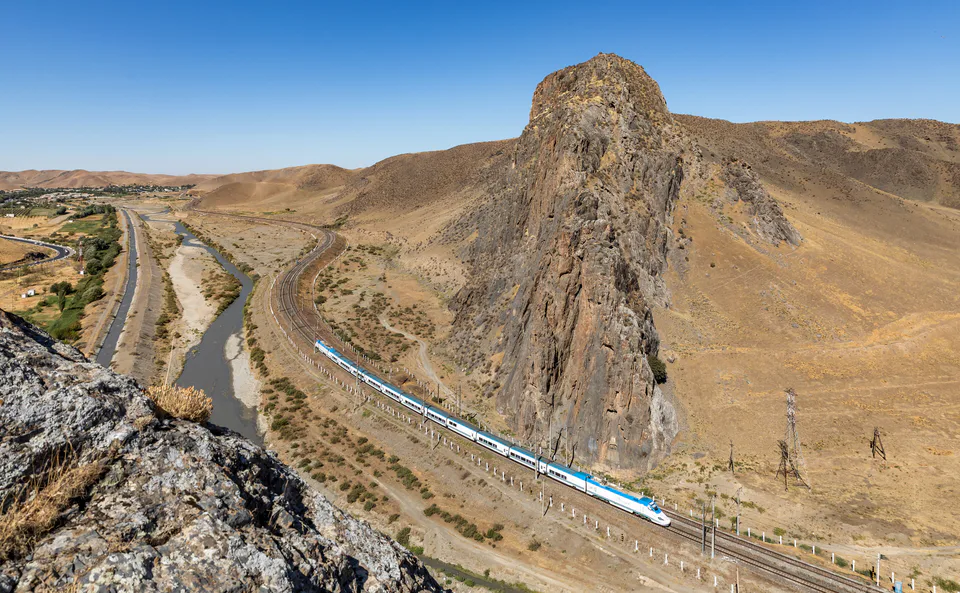
In 2011 the Afrosiyob high-speed train, built by Spain's Talgo, began running between Tashkent and Samarkand, later extended to Karshi and Bukhara. On 22 June 2016 the 123-kilometre electrified Angren–Pap railway opened. Running through a tunnel of more than 19 km beneath the Kamchik Pass, it linked the Fergana Valley directly with the rest of the country; trains had previously crossed Tajik territory. The $1.9 billion project took five years, with the tunnel built by a Chinese contractor. Passenger services began on 1 September 2016.
After the death of Islam Karimov, Shavkat Mirziyoyev was elected president in December 2016. A 2017–2021 Action Strategy was followed by the 2022–2026 “New Uzbekistan” development strategy. Free currency conversion was introduced in September 2017; from 2018–2019 visa-free entry and e-visas were opened to citizens of dozens of countries, and border crossings with neighbouring states reopened. Forced labour in the cotton harvest was abandoned, with the International Labour Organization reporting no systemic forced labour in 2021. The changes fuelled rapid growth in tourism. Assessments of the depth of reform and of political freedoms vary.
2022
Silk Road Samarkand
15–16 September 2022
The SCO summit in Samarkand
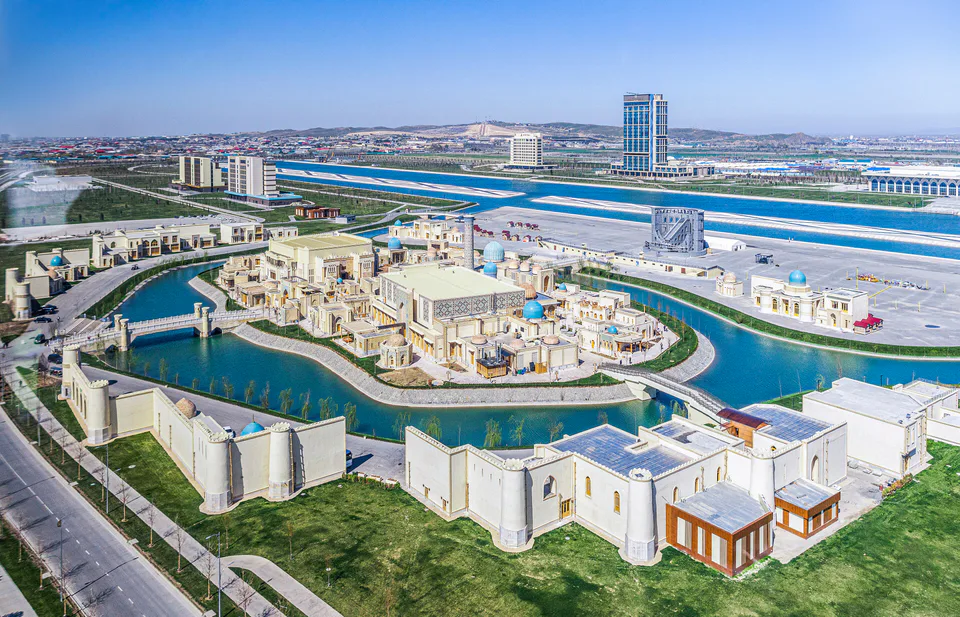
On 15–16 September 2022 Samarkand hosted the summit of the Shanghai Cooperation Organisation's Council of Heads of State, attended by the leaders of China, Russia, India, Pakistan, Kazakhstan, Kyrgyzstan, Tajikistan and Uzbekistan as well as observer and guest states; Iran took a major step towards full membership. Shortly before, in August 2022, the Silk Road Samarkand tourist complex opened on the edge of the city, with a congress hall, hotels and the Eternal City quarter of craft workshops. Samarkand has since become a venue for major international forums.
In a nationwide referendum on 30 April 2023, Uzbekistan adopted a new edition of its constitution, which took effect on 1 May. According to official figures, more than 84% of voters took part and over 90% of them approved the changes. The number of articles rose from 128 to 155; Uzbekistan was declared a social state, the sections on human rights and social guarantees were expanded, and the presidential term was lengthened from five to seven years. Early presidential elections followed in July 2023, in which Shavkat Mirziyoyev was re-elected.
2025
Silk Road Samarkand
30 October – 13 November 2025
UNESCO's General Conference in Samarkand
From 30 October to 13 November 2025 Samarkand hosted the 43rd session of the UNESCO General Conference — the first time since Sofia in 1985 that the organisation's supreme body met outside its Paris headquarters, as member states had unanimously decided in 2023. Held at the Silk Road Samarkand congress centre, the session elected Egypt's Khaled El-Enany as Director-General on 6 November. An international scholarly conference, “Samarkand: A Heritage of Three Millennia”, held alongside it, presented findings that the city's history goes back at least 3,000 years.