Modern · Shirin
Syrdarya Thermal Power Station
Central Asia’s largest power plant
Modern · Shirin
A hydropower plant on the Syr Darya where the river leaves the Fergana Valley, built in 1943–1948; its headworks supply water to the whole Hungry Steppe.
The decision to build the Farkhad station was taken on 18 November 1942, at the height of the Second World War, and work began on 10 February 1943. It was a “people’s construction”, built largely by mass volunteer labour, or hashar: more than 60,000 people came from the Fergana, Namangan, Samarkand, Bukhara, Andijan and Tashkent regions. German and especially Japanese prisoners of war were also widely used. The chief architect was Iosif Karakis.
The first turbine started in 1948 and the station reached full output in June 1949. From 1949 to 1970 it was the largest hydropower plant in Uzbekistan. Its installed capacity today is 128.24 MW.
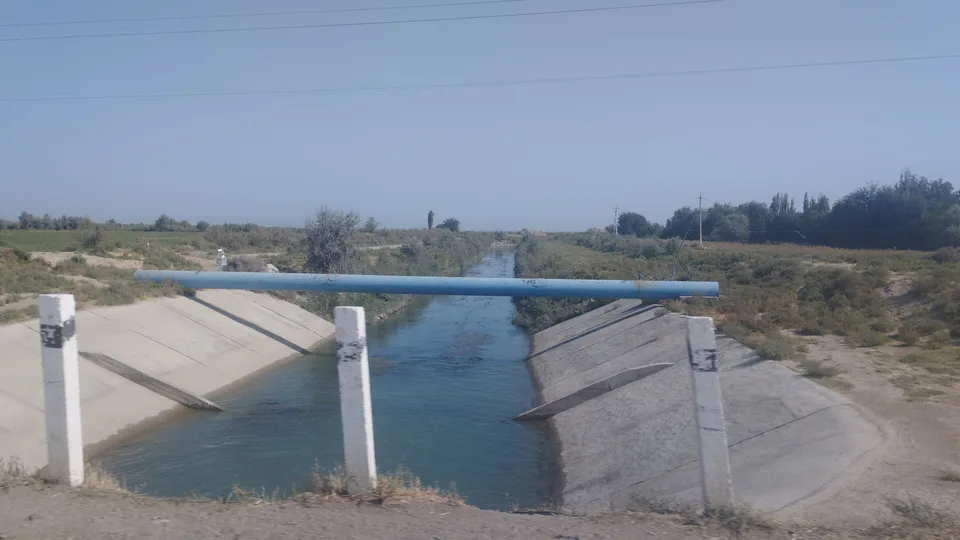
The complex stretches over 22 km. The head dam lies in Tajikistan, where the Syr Darya breaks out of the Fergana Valley through the Farkhad hills, and a diversion canal about 11 km long carries water to the powerhouse. The Farkhad Reservoir behind the dam was originally 46 km long but has silted up heavily and filled with reeds.
The station does more than generate power: the Dalverzin, Bekabad, South Hungry Steppe and Dustlik canals all start from its headworks, and the irrigation of the entire Hungry Steppe depends on it. The names of the station and of the neighbouring town of Shirin recall Alisher Navoi’s poem Farhad and Shirin; in folk legend Farhad is the hero who cut through a mountain to bring water to the steppe.